
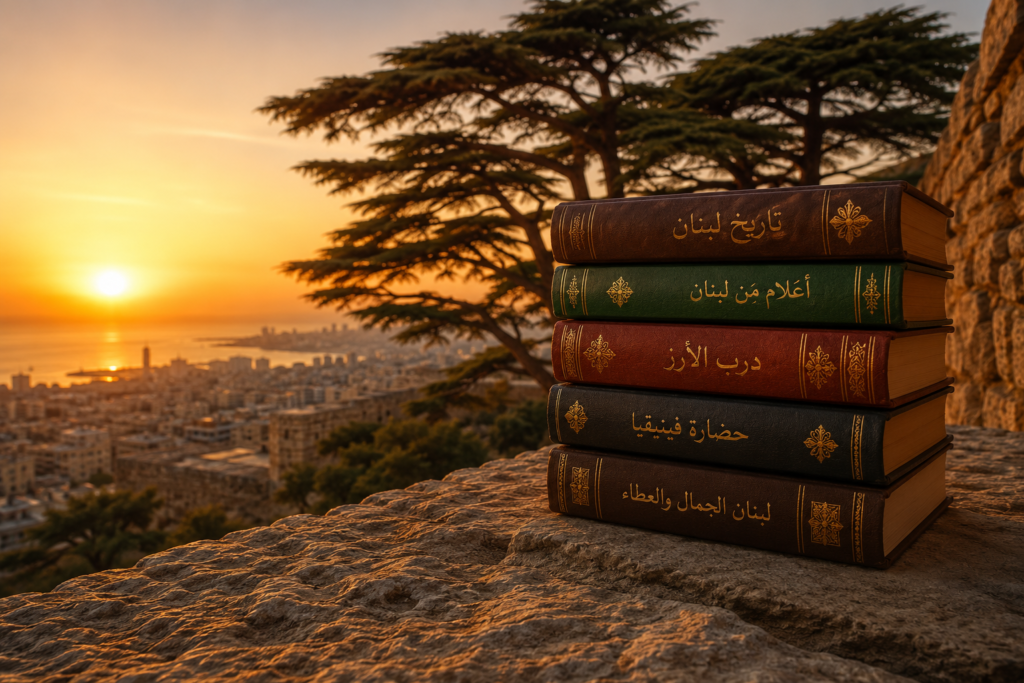
Top 10 Books About Lebanon Every Reader Needs in 2026
There are countries you visit. And then there are countries that visit you — that take up permanent residence in your imagination long after you have closed the last book written about them.
Lebanon is the second kind.
A nation of four million people that has produced a disproportionate share of the world’s finest writers, journalists, and intellectuals. A country whose geography — squeezed between Syria, Israel, and the Mediterranean — has made it the perpetual stage for conflicts far larger than itself. A civilization that has been conquered, colonized, rebuilt, destroyed, and rebuilt again so many times that resilience is not a virtue here — it is simply a survival mechanism.
To read about Lebanon is to encounter one of the great human stories of the modern era. It is to grapple with questions about identity, belonging, war, memory, and what it means to love a place that keeps breaking your heart.
These ten books are the essential starting point for that journey.
Why Lebanon Produces Such Extraordinary Literature
Before the list, a word about why Lebanon generates such remarkable writing.
The reasons are structural as much as cultural. Lebanon has historically had one of the highest literacy rates in the Arab world, a multilingual educated class comfortable writing in Arabic, French, and English, and a diaspora scattered across six continents that carries the country’s stories to global audiences.
Add to that the raw material of lived experience — fifteen years of civil war, multiple foreign invasions, political assassinations, economic collapse, and one of the largest non-nuclear explosions in history in the 2020 Beirut port blast — and you have the conditions for literature of extraordinary intensity.
These are not books written from a comfortable distance. They are books written from inside the experience.
- Pity the Nation — Robert Fisk Published: 1990 Genre: Journalism / History Why Read It: The definitive eyewitness account of Lebanon’s civil war and the 1982 Israeli invasion
Robert Fisk spent decades on the ground in Beirut as a foreign correspondent, and this monumental work is the culmination of that extraordinary career. Written with moral urgency and journalistic precision, it documents the Lebanese civil war and the Israeli invasion of 1982 with an intimacy and detail that no other book matches.
Fisk was present at some of the most consequential and horrifying moments of modern Lebanese history — including the Sabra and Shatila massacre — and he writes about them with a clarity and fury that refuses to sanitize or distance.
This is not comfortable reading. It is essential reading — the kind of book that changes how you understand a country, a conflict, and the nature of war itself.
What makes Fisk’s account particularly valuable in 2026 is how clearly it illuminates the structural forces that continue to shape Lebanon today. The same geopolitical dynamics, the same sectarian tensions, the same pattern of external powers using Lebanon as a proxy battlefield — all of it is laid out here with devastating clarity.
If you read only one book about Lebanon’s modern history, this is it.
Search Keywords: Robert Fisk Lebanon, Pity the Nation, Lebanon civil war book, Beirut 1982
- House of Stone — Anthony Shadid Published: 2012 Genre: Memoir / History Why Read It: The most beautiful book ever written about Lebanese identity and belonging
Pulitzer Prize-winning journalist Anthony Shadid returned to his ancestral village of Marjayoun in southern Lebanon to restore his great-grandfather’s crumbling stone house. What emerged from that experience is one of the most luminous and moving books in modern American literature.
House of Stone operates simultaneously on multiple levels. It is a family history tracing Shadid’s Lebanese-American roots across generations and continents. It is a portrait of a village — its characters, its rhythms, its sorrows. It is a meditation on what home means when the home you are searching for exists more in memory and imagination than in physical reality. And it is a profound reflection on identity — what it means to be Arab, American, Lebanese, and human all at once.
Shadid’s prose is extraordinary — precise, lyrical, deeply empathetic. He writes about Lebanon with the love of someone for whom the country is not a story to cover but a part of himself to understand.
Shadid died in 2012 at the age of 43, before fully seeing the impact of this masterpiece. It stands as both a great work of literature and a heartbreaking reminder of what was lost when he died.
Search Keywords: Anthony Shadid House of Stone, Lebanese American memoir, belonging and identity Lebanon
- De Niro’s Game — Rawi Hage Published: 2006 Genre: Literary Fiction Why Read It: The greatest novel ever written about Beirut during the civil war
Rawi Hage’s debut novel announced the arrival of one of the most distinctive literary voices of his generation — and went on to win the IMPAC Dublin Literary Award, one of the world’s most prestigious fiction prizes.
Set in the rubble of war-torn Beirut, the novel follows two childhood friends — Bassam and George — whose paths diverge with fatal consequences as the city collapses around them. Hage writes with savage, electric poetry. His Beirut is a city simultaneously terrifying and achingly alive — a place where ordinary life continues in the shadow of extraordinary violence, where people fall in love and drink wine and argue about football while bombs fall nearby.
The novel captures something about survival, friendship, moral compromise, and the seductive pull of violence that very few books manage to articulate. It is not a comfortable read. It is a necessary one — the kind of fiction that reveals truths about human nature that journalism and history cannot quite reach.
For readers approaching Lebanon through literature for the first time, this is the novel that will make the country unforgettable.
Search Keywords: De Niro’s Game Rawi Hage, Beirut civil war novel, Lebanese fiction IMPAC award
- Beirut Blues — Hanan al-Shaykh Published: 1992 Genre: Literary Fiction Why Read It: The most intimate and emotionally intelligent portrait of living through war
Hanan al-Shaykh is one of the Arab world’s most celebrated and internationally recognized novelists, and this work — written during the Lebanese civil war itself — remains her most viscerally powerful.
Told through a series of letters written by a young Lebanese woman who refuses to join the exodus and leave her devastated city, the novel captures the surreal, exhausting, darkly absurd experience of continuing to live in a place that is destroying itself. Al-Shaykh writes with extraordinary emotional intelligence — her protagonist’s refusal to leave is not heroism exactly, but something more complicated and more human: an attachment to place so deep it cannot be reasoned away even when reason demands departure.
The novel’s great achievement is its refusal to sentimentalize. There is dark humor here alongside the grief. There is pettiness alongside nobility. There is the bizarre mundanity of ordinary life persisting inside extraordinary catastrophe — going to the market, falling in and out of love, arguing with neighbors — while everything falls apart.
It is a portrait of a city and a people that remains as relevant and as moving today as when it was written.
Search Keywords: Hanan al-Shaykh Beirut Blues, Arab women writers, Lebanese civil war literature
- The Hakawati — Rabih Alameddine Published: 2008 Genre: Literary Fiction Why Read It: The most ambitious and dazzling work of Lebanese-American literature
Rabih Alameddine’s sprawling, intricately constructed novel is unlike anything else in Lebanese or Arab-American literature — a story within a story within a story, weaving together Arab folklore, family saga, religious mythology, and the sweep of Lebanese history across multiple generations.
The title means “the storyteller” in Arabic, and the novel is fundamentally a celebration of storytelling itself — of the ancient Arab tradition of oral narrative as a form of identity preservation, community building, and meaning-making in the face of chaos and loss.
The ambition of the book is extraordinary. Alameddine moves between medieval Baghdad and twentieth-century Beirut, between biblical stories and contemporary family drama, between tragedy and comedy, with a confidence and control that makes the formal complexity feel effortless.
This is not a quick or easy read. It rewards patience with extraordinary richness — a novel that expands your sense of what fiction can do and what Lebanese culture contains.
Search Keywords: Rabih Alameddine Hakawati, Lebanese American fiction, Arab storytelling novel
- A History of the Arab Peoples — Albert Hourani Published: 1991 Genre: History Why Read It: The single most authoritative history of the Arab world in English
No reading list about Lebanon is complete without Albert Hourani’s masterwork — widely regarded as the definitive history of the Arab world written in the English language.
Hourani, himself of Lebanese origin, traces the development of Arab civilization from the emergence of Islam in the seventh century through the political upheavals of the twentieth century with a clarity, balance, and intellectual generosity that remains unmatched. He moves with equal authority through theology, philosophy, literature, politics, and economics — always keeping human experience at the center of the historical narrative.
To understand Lebanon, you must understand the broader Arab world that shaped it — its religious traditions, its intellectual heritage, its encounter with colonialism and modernity. No single book provides that foundation more effectively than this one.
It is a book that scholars read for its rigor and general readers read for its accessibility — a rare and valuable combination.
Search Keywords: Albert Hourani Arab Peoples, Middle East history book, Arab civilization history
- The Rock of Tanios — Amin Maalouf Published: 1993 Genre: Literary Fiction Why Read It: A Prix Goncourt masterpiece from Lebanon’s greatest living writer
Amin Maalouf is Lebanon’s most internationally celebrated living writer — a member of the Académie française, a Prix Goncourt winner, and one of the most elegant prose stylists working in any language. His work has been translated into dozens of languages and read by millions of readers worldwide.
This novel, which won the Prix Goncourt in 1993, is set in a nineteenth-century Lebanese mountain village and follows a young man of mysterious origins whose story becomes entangled with the great political and religious tensions of his era. Maalouf uses the historical setting with extraordinary skill — the nineteenth century Lebanon he depicts illuminates the sectarian dynamics and power structures that would shape the country’s modern history in ways that feel revelatory rather than schematic.
The novel’s themes — identity, legitimacy, honor, the weight of community expectation on the individual — are rendered with psychological depth and narrative elegance that marks all of Maalouf’s finest work.
For readers new to Maalouf, this is the ideal entry point into one of the great literary careers of the past half century.
Search Keywords: Amin Maalouf Rock of Tanios, Prix Goncourt Lebanon, Lebanese French literature
- Beware of Small States — David Hirst Published: 2010 Genre: History / Political Analysis Why Read It: The most comprehensive analysis of Lebanon’s geopolitical trap
David Hirst spent fifty years reporting from the Middle East — longer than almost any other Western journalist — and this book is the culmination of that extraordinary career of observation and analysis.
The title captures the book’s central argument with devastating economy. Lebanon has always been too small to control its own destiny and too strategically significant — geographically, demographically, symbolically — to be left alone by the larger powers surrounding it. The result has been a history of perpetual interference, proxy conflict, and foreign-imposed suffering that Hirst traces from the Ottoman period through the twenty-first century.
What makes this book essential rather than merely informative is Hirst’s ability to combine granular reporting detail with structural political analysis. He understands both the individual human stories — the specific people, decisions, and accidents that shaped events — and the larger forces that constrained and directed them.
For anyone trying to understand why Lebanon’s problems keep recurring — why the same dynamics reassert themselves across decades — this book provides the most cogent and comprehensive answer available.
Search Keywords: David Hirst Lebanon, Beware of Small States, Lebanon geopolitics Middle East
- An Unnecessary Woman — Rabih Alameddine Published: 2013 Genre: Literary Fiction Why Read It: The most moving portrait of Beirut and the interior life ever written
Rabih Alameddine appears twice on this list because he deserves to — and because this later, more intimate novel is a completely different achievement from The Hakawati, equally extraordinary in its own quieter register.
The novel follows Aaliya, a seventy-two-year-old Beirut woman who has spent her entire adult life secretly translating great works of world literature into Arabic — never showing the translations to anyone, storing them in boxes in her apartment. As the novel opens, an accident threatens her life’s secret work, and she reflects on the books, the city, and the solitude that have defined her existence.
The result is one of the most profound meditations on literature, beauty, loneliness, and the dignity of an interior life ever written. Alameddine’s Aaliya is one of the great characters in contemporary fiction — prickly, brilliant, fiercely independent, heartbreakingly alone, and utterly alive on every page.
Set against the backdrop of modern Beirut — its neighborhoods, its sounds, its particular quality of light — the novel is also one of the most loving portraits of a city in recent literature.
It was longlisted for the Baileys Women’s Prize for Fiction and introduced Alameddine to a significantly wider international audience. It deserves every reader it can find.
Search Keywords: An Unnecessary Woman Rabih Alameddine, Beirut literary fiction, women in Arab literature
- Lebanon: A History — Kamal Salibi Published: 1988 Genre: History Why Read It: The essential academic history of Lebanon by its greatest historian
Kamal Salibi was Lebanon’s most distinguished historian — a scholar of extraordinary range and rigor whose work fundamentally shaped how the country understands its own past.
This concise but comprehensive history traces Lebanon from ancient Phoenicia through the Ottoman period, the French Mandate, independence, and the early stages of the civil war with a clarity and balance that remain unmatched in the academic literature. Salibi is particularly valuable on the complex question of Lebanese identity itself — the competing historical narratives about what Lebanon is, where it comes from, and who its people are that continue to fuel political conflict today.
Unlike some of the other books on this list, this is explicitly a work of academic history rather than literary nonfiction — but Salibi writes with enough clarity and narrative skill to make it accessible to general readers willing to engage seriously with the material.
For anyone who wants to understand Lebanon’s history as the Lebanese themselves understand it — through the lens of their own most respected scholarship — this is the indispensable starting point.
Search Keywords: Kamal Salibi Lebanon history, Lebanese historiography, Phoenicia to modern Lebanon
Reading Lebanon: Where to Begin If you are new to Lebanese literature and history and unsure where to start, here is a suggested reading order based on accessibility and impact:
Start with House of Stone by Anthony Shadid — it is the most immediately accessible and emotionally engaging entry point, a memoir that reads like the finest literary nonfiction.
Follow it with De Niro’s Game by Rawi Hage — the novel that will make Beirut unforgettable.
Then turn to Pity the Nation by Robert Fisk for the historical and journalistic foundation that will deepen everything else you read.
From there, the rest of the list opens up — each book adding new dimensions, new perspectives, new layers to your understanding of one of the world’s most complex and compelling nations.
The Lebanon That Literature Reveals These ten books do not tell a single coherent story about Lebanon. They tell dozens of stories — contradictory, overlapping, written from radically different perspectives and in radically different registers.
That multiplicity is itself the point.
Lebanon resists simple narratives. It always has. The country is too layered, too contradictory, too simultaneously ancient and modern, Eastern and Western, sacred and secular to be captured in a single account.
What these books share is not a unified thesis about Lebanon but something more valuable: a commitment to rendering the country’s complexity honestly — its beauty alongside its violence, its extraordinary creative energy alongside its catastrophic political failures, its people’s remarkable resilience alongside their capacity for self-destruction.
To read these books is not to understand Lebanon completely. It is to begin to understand why Lebanon matters — why this small, battered, magnificent country at the eastern edge of the Mediterranean has produced so much great literature, so much great journalism, so much great art, and why it continues to demand the world’s attention even when — especially when — the world would prefer to look away.
Pick up any book on this list. Lebanon will take care of the rest.