
Automotive System-on-Chips (SoCs) are the single component reshaping how modern cars sense, decide, and react — processing more data per second than the computers that guided the Apollo missions to the moon.
Most drivers never think about this. But if you’ve noticed your car braking a split-second before you saw the hazard yourself, or nudging the wheel back into lane on a long highway stretch, that instinct isn’t magic — it’s a SoC processing dozens of signals in real time.
Your Car Is Getting Smarter — And Most Drivers Have No Idea Why
Something extraordinary is happening inside modern vehicles. Not in the engine. Not in the battery. Not even in the sleek touchscreen dominating your dashboard. It is happening inside a piece of silicon smaller than your thumbnail — a chip that processes more data every second than the computers that guided astronauts to the moon half a century ago.
These chips are called Automotive System-on-Chips — SoCs. And they are quietly, invisibly, and fundamentally transforming every journey you take. They are the reason your car can see hazards you cannot. The reason it can react faster than you can blink. The reason the vehicle you drive today is measurably, provably safer than anything your parents drove — and why the vehicle you will drive in ten years will make today’s cars look primitive.
This is not a story about robots replacing drivers. This is a story about how cutting-edge semiconductor technology is making every road safer, every journey smarter, and every vehicle more connected — whether you are driving a budget hatchback or a six-figure luxury SUV.
And it is a story that is only just beginning.
What Exactly Is an Automotive SoC — And Why Should You Care?
A System-on-Chip is exactly what it sounds like: an entire computer compressed onto a single chip. Processor, memory, graphics engine, AI accelerator, communication interfaces — all working together on one piece of silicon roughly the size of a fingernail.
In consumer electronics, SoCs power your smartphone and tablet. They are optimized for performance, efficiency, and cost — but they can afford occasional errors. A frozen app is annoying. A frozen safety system at 120 kilometers per hour is catastrophic.
Automotive SoCs operate under an entirely different set of demands. They must work flawlessly in temperatures ranging from Arctic cold to desert heat. They must survive constant vibration, moisture, and dust. They must process massive amounts of data without interruption, without error, and without hesitation — for years, not months.
And they must do all of this while processing an almost incomprehensible volume of sensor data every single second:
- Multiple cameras scanning every direction simultaneously for pedestrians, cyclists, and obstacles
- Radar systems tracking the speed and distance of every vehicle within hundreds of meters
- LiDAR sensors mapping the three-dimensional environment around the vehicle in real time
- Ultrasonic sensors monitoring the immediate vicinity for low-speed maneuvering
- GPS and mapping systems calculating precise position to centimeter-level accuracy
- Vehicle health monitors tracking hundreds of mechanical and electrical parameters simultaneously
Every piece of this data needs to be collected, processed, fused into a coherent picture of the world, and acted upon — all within milliseconds. That is the job of the automotive SoC. And doing it well is the difference between a car that merely drives and a car that genuinely thinks.
Understanding ADAS: The Technology That Is Already Saving Lives
Advanced Driver Assistance Systems — ADAS — is the collective name for the safety and automation features that automotive SoCs make possible. The term sounds clinical and technical. The reality is deeply personal.
Road accidents kill approximately 1.35 million people every year worldwide. The overwhelming majority of those deaths involve human error — distraction, fatigue, misjudgment, delayed reaction. ADAS technology directly addresses every one of those failure modes. It does not get tired. It does not get distracted. It does not misjudge distances after a long shift or a poor night’s sleep.
You interact with ADAS technology every single day, often without realizing it. Every time your car gently nudges you back into your lane — that is ADAS. Every time the brakes engage before you have even registered a hazard ahead — that is ADAS. Every time a warning light illuminates because something has entered your blind spot — that is ADAS.
Automatic Emergency Braking — The Feature That Changes Everything
Of all the ADAS features enabled by automotive SoCs, Automatic Emergency Braking deserves special attention. It is the feature that has already saved the most lives and has the clearest, most direct impact on road safety statistics.
The system works by continuously fusing data from forward-facing cameras and radar to build a real-time picture of everything ahead of the vehicle. When the SoC’s algorithms determine that a collision is imminent and the driver has not responded, the system triggers full emergency braking automatically — faster than any human nervous system can react.
The numbers are striking. Studies consistently show that AEB reduces rear-end collisions by between 38 and 50 percent. In absolute terms — given the scale of global road traffic — that translates to hundreds of thousands of accidents prevented every year, and tens of thousands of lives saved.
This is not a future technology. It is running in vehicles on roads everywhere today, quietly preventing accidents that would otherwise be inevitable.
Lane Keeping and Lane Centering
Lane departure is responsible for a disproportionate share of serious road accidents — particularly on motorways and highways where vehicles travel at high speed and a momentary distraction can have catastrophic consequences.
Automotive SoCs process continuous video feeds from forward-facing cameras using computer vision algorithms that can detect lane markings in real time — even in rain, at night, and in conditions that challenge human visibility. When the vehicle begins drifting from its lane without an active turn signal, the system responds with either an alert or a gentle steering correction.
More advanced implementations — lane centering — go further. Rather than simply correcting drift, they actively maintain the vehicle’s position in the center of the lane continuously, making long-distance highway driving dramatically less fatiguing and significantly safer.
Adaptive Cruise Control — Smarter Than Its Name Suggests
Traditional cruise control maintains a fixed speed regardless of traffic conditions. The driver must disengage it every time traffic slows. Adaptive Cruise Control — powered by automotive SoC radar processing — transforms this dynamic entirely.
The system continuously monitors the vehicle ahead and automatically adjusts speed to maintain a safe following distance — slowing when traffic slows, accelerating when it clears, and bringing the vehicle to a complete stop in traffic jams before automatically resuming when movement resumes. On congested motorways, the reduction in driver fatigue is significant. The reduction in rear-end collisions from distracted driving is measurable.
Blind Spot Detection and Cross-Traffic Alert
The human blind spot is responsible for thousands of accidents every year — lane changes that clip unseen vehicles, reversing maneuvers that cross paths with approaching traffic. Automotive SoC-powered radar systems eliminate this vulnerability entirely.
Radar sensors on both sides of the vehicle feed continuous data to the SoC, which monitors the areas outside the driver’s field of vision at all times. A warning light in the relevant door mirror activates the moment another vehicle enters the blind spot zone. Cross-traffic alert extends this monitoring to the rear of the vehicle when reversing — warning of approaching vehicles that would be invisible in mirrors alone.
Traffic Sign Recognition and Speed Assist
Using AI models running directly on the automotive SoC, modern vehicles can read and interpret road signs in real time — speed limits, no-entry signs, overtaking restrictions, variable speed limit displays. The current sign is displayed on the dashboard instrument cluster, giving the driver instant awareness of applicable restrictions.
More advanced implementations connect this information to Intelligent Speed Assistance systems — which can automatically adjust vehicle speed to comply with the applicable limit, with driver override always available. As European regulations increasingly mandate ISA technology, this feature is transitioning from premium option to standard equipment across the industry.
Automated Parking Systems
Parking stress is one of the most universally experienced frustrations of urban driving. Automotive SoC-powered parking systems are transforming this experience entirely. By combining ultrasonic sensors, cameras, and precise motor control coordination, these systems can identify suitable parking spaces as the vehicle passes them, calculate the optimal entry maneuver, and execute parallel or perpendicular parking automatically while the driver simply controls the accelerator and brake pedal.
The most advanced implementations — remote parking and automated valet systems — allow drivers to exit the vehicle first and then park it remotely using a smartphone app. These systems require the full sensor fusion capability of the latest generation automotive SoCs.
The Companies Racing to Define the Future of Automotive SoCs
The race to build the most powerful, efficient, and safe automotive SoC is one of the most consequential technology competitions of our era — attracting billions in investment from the world’s most capable semiconductor companies and creating a battlefield where the automotive and consumer electronics industries are colliding at speed.
| Company | Platform | Key Strength | Major Partners |
|---|---|---|---|
| NVIDIA | Drive Thor | AI processing power | Mercedes, Volvo, BYD |
| Qualcomm | Snapdragon Ride Elite | Scalability + 5G integration | BMW, Honda, Renault |
| Intel/Mobileye | EyeQ Ultra | Vision-based ADAS leadership | VW, Ford, Nissan |
| NXP Semiconductors | S32 Platform | Safety certification depth | GM, Toyota, Stellantis |
| Renesas | R-Car Series | Production volume reliability | Toyota, Honda, Mazda |
NVIDIA Drive Thor — The AI Powerhouse
NVIDIA entered the automotive SoC market with a clear strategic thesis: the future of autonomous driving is fundamentally an AI problem, and no company understands large-scale AI processing better than NVIDIA.
The Drive Thor platform delivers extraordinary AI processing performance — measured in thousands of TOPS (Tera Operations Per Second) — enough computational headroom to handle not just current ADAS requirements but the full demands of Level 4 and Level 5 autonomous operation. It consolidates what previously required multiple separate processors onto a single chip, reducing vehicle complexity and cost while dramatically increasing capability.
Mercedes-Benz, Volvo, and BYD are among the automakers that have committed to NVIDIA’s automotive platform — a roster that validates the technical credibility of the approach and signals that the AI-first thesis for automotive computing has significant industry support.
Qualcomm Snapdragon Ride Elite — The Mobile Giant Enters the Fast Lane
Qualcomm’s decision to enter the automotive SoC market with full commitment was one of the most significant strategic moves in the semiconductor industry of the past decade. The company brings to the automotive sector the same scalable platform approach that made Snapdragon the dominant mobile processor architecture globally.
Snapdragon Ride Elite is designed to scale from basic ADAS features in mainstream vehicles all the way to highly automated driving in premium models — using the same fundamental architecture across the entire range. This scalability is enormously valuable for automakers who want to maintain a consistent software development environment across their entire vehicle lineup.
Qualcomm’s deep expertise in 5G connectivity integration gives the Snapdragon Ride platform a distinctive advantage as vehicles become increasingly connected — enabling vehicle-to-vehicle and vehicle-to-infrastructure communication that will be essential for the next generation of cooperative safety systems.
Intel Mobileye EyeQ Ultra — The ADAS Pioneer Pushes Toward Autonomy
Mobileye has a legitimate claim to having invented the modern ADAS market. Its EyeQ chip series is deployed in hundreds of millions of vehicles worldwide — more than any competitor — giving it an unmatched dataset of real-world driving experience that feeds back into its AI model development.
The EyeQ Ultra represents Mobileye’s push beyond ADAS toward genuine autonomous capability. Its camera-first philosophy — the conviction that visual perception, processed with sufficient intelligence, can replicate and exceed human visual capability — is backed by the largest real-world autonomous driving dataset ever assembled.
The Five Trends Shaping the Next Generation of Automotive SoCs
1. Zone Architecture Replacing Distributed ECUs
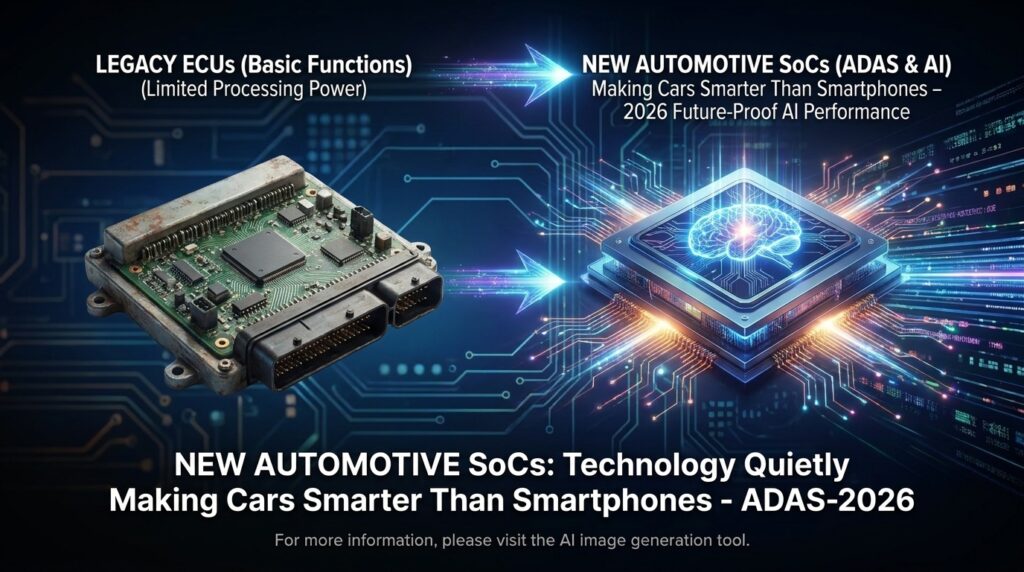
Traditional vehicles used dozens of separate Electronic Control Units scattered throughout the vehicle — each responsible for a single specific function. A modern premium vehicle might contain 100 or more separate ECUs, connected by kilometers of wiring harness, adding weight, complexity, and cost while creating numerous potential points of failure.
New high-performance automotive SoCs are powerful enough to consolidate multiple functions onto a single processor. The industry is transitioning to zone architecture — where a small number of powerful central compute units replace the distributed ECU network. The result is simpler, lighter, cheaper, and more reliable vehicles with dramatically reduced wiring complexity.
2. The Software-Defined Vehicle Revolution
The most profound shift enabled by new automotive SoCs is the emergence of the software-defined vehicle — a car whose capabilities can be meaningfully updated, expanded, and improved through over-the-air software updates throughout its operational life.
Tesla demonstrated the commercial viability of this concept. Every major automaker is now pursuing it aggressively. The implications are significant: vehicle ownership becomes a continuously improving experience rather than a static one. Safety features improve after purchase. New capabilities unlock. Performance characteristics evolve.
Your car in three years could be meaningfully safer and more capable than your car today — with identical hardware. This represents a fundamental transformation in what it means to own and operate a vehicle.
3. Edge AI as the Defining Competitive Advantage
The ability to run sophisticated AI models directly on the vehicle — without cloud connectivity — is becoming the primary competitive differentiator in automotive semiconductors. Cloud-dependent systems introduce latency. In safety-critical driving situations, milliseconds matter. A system that must communicate with a remote server before making a braking decision is fundamentally unsuited for real-world deployment.
The automotive SoC companies that achieve the best combination of AI model capability and on-device processing efficiency will define what autonomous driving looks like for the next decade. This is why NVIDIA, Qualcomm, and Mobileye are investing billions in edge AI architecture — and why the competition between them is intensifying rather than consolidating.
4. ISO 26262 and Functional Safety as Non-Negotiable Foundation
The automotive industry operates under safety standards that have no equivalent in consumer electronics. ISO 26262 — the international standard for functional safety in road vehicles — defines a rigorous framework for designing, developing, and validating safety-critical electronic systems.
Meeting ISO 26262 at the highest levels requires redundant processing architectures that can detect and correct hardware errors before they propagate to safety-critical functions. It requires extensive validation testing across thousands of operating scenarios. And it requires documentation and traceability standards that add significant cost and time to the development process.
For automotive SoC developers, functional safety is not a feature — it is the foundation on which everything else is built. A chip that delivers extraordinary AI performance but cannot meet ISO 26262 certification requirements will not find its way into production vehicles.
5. Vehicle-to-Everything Communication Integration
The next frontier in automotive safety goes beyond what individual vehicles can perceive independently. Vehicle-to-Everything — V2X — communication allows vehicles to share real-time information with each other, with road infrastructure, with traffic management systems, and with vulnerable road users.
A vehicle equipped with V2X can know about a collision around a blind corner before it comes into camera or radar range. It can receive real-time signal phase information from traffic lights — optimizing speed for green wave progression and eliminating unnecessary braking. It can receive warnings about pedestrians and cyclists that have entered an intersection from angles its own sensors cannot cover.
Integrating V2X capability into automotive SoCs — alongside the sensor processing, AI inference, and vehicle control functions already running on the same chip — is one of the most demanding challenges in semiconductor design today. The companies that solve it will define the connected vehicle ecosystem of the next decade.
The Levels of Autonomous Driving — An Honest Assessment of Where We Stand
Understanding the current state of automotive SoC technology requires understanding the framework used to describe driving automation levels. The SAE International defines six levels:
| Level | Name | What It Means | Real-World Status 2026 |
|---|---|---|---|
| 0 | No Automation | Driver controls everything always | Legacy vehicles only |
| 1 | Driver Assistance | Single automated function active | Universal in new vehicles |
| 2 | Partial Automation | Multiple functions simultaneously | Standard in most new vehicles |
| 3 | Conditional Automation | System drives, human must be ready | Limited — Mercedes, Honda |
| 4 | High Automation | No human needed in defined conditions | Robotaxi services only |
| 5 | Full Automation | No human needed anywhere, ever | Not yet achieved anywhere |
The honest assessment: most new vehicles sold globally in 2026 operate at Level 2. Level 3 is available from a small number of manufacturers in specific markets and operating conditions. Level 4 exists only in controlled robotaxi deployments in a handful of cities. Level 5 remains a research objective rather than an engineering reality.
This is not a failure. Moving from Level 0 to Level 2 — which the industry has accomplished in roughly fifteen years — represents an extraordinary achievement in engineering, validation, and regulatory navigation. The benefits at Level 2 alone — measured in accidents prevented and lives saved — already justify the investment made.
The Uncomfortable Truth About Full Autonomy Timelines
Full self-driving has been described as two years away for roughly a decade. The honest picture is more nuanced — and more interesting — than either the optimist or pessimist narrative suggests.
The hardware capability for high-level autonomy exists or is within reach. Current and near-future automotive SoCs have sufficient processing power to handle the computational demands of Level 4 and potentially Level 5 operation. This is no longer the limiting factor it once was.
The genuine unsolved problems are elsewhere. Software that handles edge cases — the rare, unexpected, deeply ambiguous situations that fall outside the training distribution of any AI model — remains a fundamental challenge. Regulatory frameworks that define liability, testing requirements, and operational design domains are still being developed in most major markets. Public trust in autonomous systems requires a safety track record that can only be built gradually through real-world deployment.
None of these problems are insurmountable. But none of them will be solved by more processing power alone. The path to widespread Level 4 and Level 5 autonomy runs through software maturity, regulatory clarity, and public acceptance as much as through semiconductor advancement.
What Automotive SoC Innovation Means Beyond the Car Industry
The implications of automotive SoC development extend far beyond transportation — into territory that will shape the broader technology landscape for decades.
The processing architectures being developed for automotive AI are advancing the state of edge computing generally — demonstrating what is possible when AI inference runs on constrained, real-time, safety-critical hardware rather than in data centers with unlimited power and cooling. These advances feed back into robotics, industrial automation, medical devices, and smart infrastructure.
The sensor fusion techniques refined for ADAS — the methods for combining multiple imperfect data streams into a coherent, reliable picture of a complex environment — are being applied in warehouse automation, construction robotics, agricultural machinery, and smart city infrastructure. The automotive industry, through the demands it places on semiconductor developers, is accelerating the entire field of machine perception.
The safety certification frameworks developed for automotive chips — the ISO 26262 standards, the ASIL rating systems, the validation methodologies — are providing a template for how society should think about safety-critical AI systems in other domains. As AI moves into medical diagnosis, infrastructure management, and financial systems, the lessons learned in automotive safety engineering will prove invaluable.
To understand the full scope of how artificial intelligence is reshaping industries beyond automotive, read our analysis of why most companies will fail at AI in 2026 — and what separates the organizations that will thrive from those that will not.
Conclusion: The Chip That Is Rewriting the Rules of the Road
The next time your car warns you about a vehicle in your blind spot, take a moment to appreciate what is actually happening beneath the surface of that simple alert.
A chip smaller than your thumbnail just received data from multiple radar sensors, processed it through an object detection algorithm, calculated the velocity and trajectory of the detected vehicle, determined that it fell within a defined risk zone, and triggered a warning — all in under ten milliseconds. Without that chip, without those algorithms, without the years of engineering and validation that produced them, you would simply not have known the vehicle was there.
That is the power of the current generation of automotive SoCs. And if development trajectories hold — if the investments being made by NVIDIA, Qualcomm, Mobileye, NXP, and the dozens of startups competing in this space continue to translate into deployable technology — what feels remarkable today will seem basic within five years.
The window that new automotive SoCs provide into the future of ADAS and autonomous driving is clear. It is a view of a world where the leading cause of accidental death — human error behind the wheel — becomes, slowly but surely, an increasingly solvable problem.
That is worth paying attention to. Whatever kind of car you drive.