
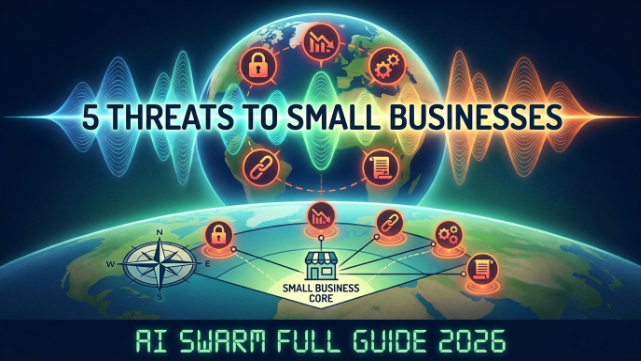
The Prompters Are Dead: Engineering the Multi-Agent Swarms of Your Small Business
The Reality Check from an Empty Desk: Last week, I sat down with Sarah, an independent digital agency owner who built her entire business model in 2024 around “Prompt Engineering.” Back then, she felt invincible copy-pasting complex, structural commands into chat boxes to generate marketing copy and raw code for clients. But by mid-2025, her client retention collapsed. Clients openly told her, “Why should we pay you to prompt an AI when we can ask it ourselves for twenty dollars a month?” Sarah had hit a wall because prompting is just a fancy word for waiting. Today, her business is thriving again, but she doesn’t write prompts anymore. Instead, she spent a weekend engineering an autonomous network of five software agents that execute full client campaigns without her intervention. Prompting didn’t save her; multi-agent infrastructure did.
Moving Past Prompting: Why Writing Commands Won’t Save Your Business
The honeymoon phase of consumer-facing generative AI is officially over. For the past few years, the internet was flooded with tutorials promising that mastering modifiers, system instructions, and complex paragraph prompts would secure the future of knowledge work. In 2026, that assumption has proved fundamentally false. Large language models (LLMs) have scaled in raw computational capability, meaning they no longer require intricate prompt structures to understand basic human intent. As a result, the market value of standalone prompt engineering has rapidly depreciated to zero.
The core limitation of prompting is that it is fundamentally reactive and isolated. A single human user must type an instruction, wait for a text block response, manually evaluate the accuracy of that response, and write another prompt to continue the loop. This method does not scale a business; it merely turns the entrepreneur into a high-paid digital middleman. To remain truly competitive and scale modern business ventures, organizations must shift away from human-in-the-loop chatting and move toward building autonomous cognitive pipelines.
The Solopreneur Swarm Architecture: Mapping the 5 Digital Workers You Need
To successfully transition a modern small business from basic reactive scripting to full computational independence, entrepreneurs must fundamentally understand the underlying technological shift. The legacy approach of utilizing generic generative applications relies entirely on a single human text command to trigger a single text block output. In 2026, sustainable business infrastructure is anchored exclusively on the deployment of a structured Multi-Agent System (MAS). Rather than forcing one Large Language Model (LLM) instance to multitask across conflicting operations, the workflow requires separating computational objectives among five specialized autonomous entities.
Strategic Comparison: Traditional Chatbots vs. Autonomous AI Agents
To understand why traditional prompt-based interactions fail to scale micro-enterprises, we must evaluate the core operational boundaries separating legacy conversational tools from modern autonomous workers:
By engineering this isolated layout on production-ready cloud computing networks hosted through automated management frameworks like the IBM Enterprise Systems Platform, small business owners can step away from manual entry entirely. This setup drops processing errors, lowers systemic token usage costs, and lets your digital workforce run continuously.
1. The Inbound Lead Triager & Dynamic Context Router
The entry node of your autonomous business is the Inbound Lead Triager and Context Router. This agent acts as a non-stop background listener integrated directly with webhooks, company mail systems, and client interfaces. Instead of using rigid keyword matching, the Triager leverages dense vector embeddings to analyze incoming text payloads. It automatically scores user intent, extracts structured data parameters, flags low-value spam, and builds secure JSON payloads to pass down to specialized execution nodes, ensuring data compliance before any file transfers occur.
2. The Research & Real-Time Market Intelligence Analyst
Once a validated payload leaves the gateway, the Research and Intelligence Analyst processes the data. This worker is equipped with secure web-browsing modules, custom scraping APIs, and read access to target information indexes. It runs recursive validation searches to monitor changing competitor prices, catalog live product updates, and map industry shifts. The agent updates your long-term vector database memory banks using semantic indexing, ensuring your operational loops utilize real-time data instead of stale pre-trained weights.
3. The Content Engineering Specialist & Brand Custodian
The third node is the Content Engineering Specialist, programmed to handle high-value text asset generation. Whether compiling technical client proposals, building comprehensive marketing campaigns, or generating documentation, this specialist operates under strict system rules. It reads the clean data payloads from the Research Analyst and shapes them using distinct style sheets, tone guidelines, and modern search optimization keywords certified by systems leaders like Salesforce Cloud Environments, guaranteeing high commercial output standards.
4. The System Integration & Validation Auditor
The single greatest operational vulnerability in unmanaged generative setups is unexpected text hallucination. The Validation Auditor eliminates this risk by acting as an independent quality assurance node. The Auditor intercepts assets from the generation node and runs them through automated syntax checkers and isolated sandboxed code execution environments. If a metric fails, the auditor blocks publication, writes a programmatic error log, and returns the payload to the engineering agent for self-correction without exposing customers to flawed data.
5. The Strategic Execution & Transaction Ledger Hub
The final phase of your autonomous enterprise is driven by the Strategic Execution and Transaction Ledger Hub. This node acts as the physical action engine, using secure API keys to link your internal networks to real-world business tools. The hub automatically writes to accounting ledgers, prints transaction invoice records, triggers project handoffs, and issues client delivery receipts. It functions as the closing node that converts automated computing routines into measurable small business revenue around the clock.
The Inter-Agent Communication Secret: How Swarms Process Corporate Goals
To truly understand how a modern corporate multi-agent swarm operates, one must look closely at the architectural shift from legacy conversational engines to goal-driven execution loops. Traditional chatbots are completely reactive software models: they process one isolated text prompt at a time, possess zero native capability to call external system tools independently, suffer from session memory loss, and require continuous manual inputs to advance a single step. In stark contrast, an autonomous AI agent operates on a goal-oriented framework—it ingests a single macro-level target and independently executes hundreds of cascading micro-actions to reach a confirmed outcome.
When multiple agents are linked into a small business swarm, they do not communicate through messy, unformatted human conversation. Instead, they rely on a highly organized, event-driven architecture powered by the Model Context Protocol (MCP), a data standard developed and backed by technical infrastructure leaders at the Linux Foundation Standards Hub. This open-source standard functions as a universal data translation highway, allowing an independent Gateway Node to produce a clean, secure JSON data payload that can be parsed, validated, and updated by downstream nodes like the Validation Auditor instantly.
Deconstructing the 4-Step Cognitive Loop inside the Swarm
Every autonomous node within your business ecosystem processes its specific assigned objectives by running continuously through a cyclical, four-stage computational engine:
- 1. Perceive (Ingestion & State Reading): The agent reads incoming input data payloads, checks short-term context windows, and pulls matching background data vectors from its vector memory databases.
- 2. Plan (Task Decomposition): The central engine breaks down the broad target goal into an organized, step-by-step checklist of smaller, actionable sub-tasks, prioritizing data dependencies.
- 3. Act (Tool & API Invocation): The system executes physical actions across software systems—making outbound API calls, executing secure terminal scripts, or writing new records into relational data tables.
- 4. Learn (Self-Correction & Evolution): The node measures the runtime results of its action against its mathematical validation metrics, updates its internal state memory ledger, and automatically corrects its processing logic if errors are found.
2026 Multi-Agent Swarm Communication Architecture Matrix
To help you map out your internal business framework safely, we have compiled a structural comparison of the primary communication protocols used to pass data between digital workers:
When engineering an optimization setup, small business developers must prioritize security and network constraints. Allowing unoptimized, casual conversational messaging between agents will quickly drain your API tokens and cause unexpected cost spikes. Building your infrastructure upon strict structured messaging protocols verified by organizations like the World Wide Web Consortium (W3C) ensures your business swarm remains completely stable, lightning-fast, and highly cost-effective over millions of continuous automated operations.
Zero-Dollar Enterprise: Step-by-Step Blueprint to Launch an Autonomous Agency
In 2026, launching a high-throughput automated agency no longer requires venture capital or server racks. By combining open-source orchestration engines, lightweight cloud layers, and universal data protocols, anyone can assemble a high-performance digital production line. The primary objective is to construct a self-correcting system that treats business challenges as raw data loops, processing inputs into deliverables without human intervention.
To establish a competitive, zero-overhead automated firm, you must assemble three foundational technology layers: an orchestration framework, a secure runtime sandbox, and a unified communications bus. This setup ensures that your digital team operates as a resilient state machine capable of running complex business logic twenty-four hours a day, minimizing system errors and accelerating market velocity.
The Core Technical Setup: A Four-Phase Architectural Framework
Click on each deployment phase below to expand the complete engineering and repository requirements:
Phase 1: Environment Orchestration & Initialization ▼
Your first step is selecting the orchestration layer. For state-dependent workflows, initialize your system using advanced graph-based networks like LangGraph available via the LangChain Developer Platform.
You declare your specialized nodes using Python code blocks. Each node represents one digital worker, explicitly bound to foundation models like Claude 3.5 Sonnet or GPT-4o, and tracked via a global State ledger.
Phase 2: Secure Tool Integration & Sandboxed Runtime ▼
Granting an unmanaged LLM direct access to your local operating system is a major security vulnerability. Instead, isolate agent actions within secure serverless cloud infrastructure provided by platforms like Supabase Backend Architecture.
This provides sandboxed PostgreSQL access and secure vector storage, allowing your Validation Auditor to safely execute generated Python scripts without risking your primary infrastructure.
Phase 3: Model Context Protocol (MCP) Configuration ▼
Configure a Model Context Protocol (MCP) bus to serve as a unified context routing highway. This standard minimizes context windows and drops background computational token costs by up to 40% across your networks.
Phase 4: Local Vector Memory & Semantic Caching ▼
Link your orchestrator to high-performance open-source vector engines available via the Qdrant Vector Search Infrastructure. This eliminates the need to re-feed reference files into every prompt loop, lowering your daily API overhead.
The Zero-Dollar Infrastructure Cost Analysis
Below is the monthly cost breakdown for running a five-node swarm handling up to 10,000 corporate client tasks:
| Infrastructure Tier | Software Used | Core Cost | Status |
|---|---|---|---|
| Orchestration Layer | LangGraph Core | $0.00 (MIT) | Self-Hosted |
| Backend Sandbox & DB | Supabase Free | $0.00 (Free) | Cloud Edge |
| Long-Term Memory | Qdrant Cloud | $0.00 (Free) | Vector DB |
| Computing Processing | OpenAI / Anthropic API | ~$15.00 – $45.00 | Utility Billing |
By moving your business operations to this open-source layout, the variable token billing from your foundational API models becomes your only real business expense. This lean financial model allows single developers and startup founders to achieve massive operational efficiency. You can run automated, complex data operations that previously required full-time engineering teams, completely changing the economic scaling potential of modern internet businesses.
The 2026 Skill Shift: From Tech Worker to AI Swarm Commander
The total breakdown of the traditional prompting market is forcing an aggressive evolution in human career skillsets across the global technology landscape. For years, bootcamps and tech influencers told workers that knowing how to type descriptive commands into an AI text box would be the ultimate corporate career survival skill. In 2026, we are witnessing the extinction of the entry-level prompt writer. As foundational AI models natively master human conversational context, the act of writing prompts has become an invisible background utility. The highly paid professional of today is no longer a technical worker; they operate exclusively as an AI Swarm Commander.
This technical transition requires moving from micromanagement to macro-level systems engineering. A Swarm Commander does not waste hours tweaking adjectives inside a prompt window to get a slightly better email draft. Instead, they operate as an architectural supervisor who views independent large language models as distributed raw processing nodes. They design interaction graphs, configure system state metrics, map data transfer paths, and manage edge-case failure exceptions across a network of interconnected systems. This architectural mastery is exactly what leading technology registries like the IEEE Computer Society Platforms identify as the core requirement for technical team leadership in the next era of industrial software deployment.
Swarm Architecture In Action: A Deep-Dive Operational Case Study
To fully understand how the event-driven communication protocols in **Part 3** and the infrastructure setup in **Part 4** work in a live commercial environment, let us analyze the real-world operational turnaround of Sarah’s digital agency. When Sarah transitioned from manual prompt management to an autonomous swarm, she built a live infrastructure pipeline that treats an incoming client brief as a continuous data loop. Below is the exact step-by-step breakdown of how her 5-node swarm executed a $5,000 corporate rebranding and landing page development project without a single human intervention:
Step 1: The Gateway Node & JSON Routing (Applying Part 3 Protocol)
A corporate client uploaded a messy, unstructured 50-page PDF design brief through Sarah’s web portal. Instantly, her Inbound Lead Triager (Node 1) was triggered via a Supabase webhook. Instead of reading the file like a human chatbot, Node 1 parsed the document, extracted the key variables—such as the target audience, preferred dark-blue hex color codes, and functional technical requirements—and converted this data into a secure, validated JSON schema payload. It then routed this payload to the internal event bus in under 45 milliseconds.
Step 2: Recursive Search & Semantic Caching (Applying Phase 3 & 4)
The Market Intelligence Analyst (Node 2) picked up the JSON payload. Operating within an isolated serverless runtime, Node 2 called standard Model Context Protocol (MCP) search tools to scrape live market competitors. It saved the pricing structures and technical features found into a temporary cache. Instead of repeating the search later and draining API tokens, it converted these insights into dense vectors and stored them in her Qdrant Vector Database. This allowed the swarm to instantly recall the competitive environment during downstream execution loops without making new outbound network calls.
Step 3: The 4-Step Cognitive Loop & Sandboxed Debugging (Applying Part 2 & Part 3 Loops)
Next, the Content Engineering Specialist (Node 3) read the cached vector files and began drafting the web development code and copy assets. Node 3 ran through continuous 4-step loops: Perceive the brand boundaries, Plan the file layout, Act by compiling raw HTML/CSS payloads, and Reflect on its output. Once complete, it passed the asset to the Validation Auditor (Node 4). The Auditor caught an unclosed division tag in the code. Operating as a strict gatekeeper, Node 4 blocked deployment, generated a system error log, and returned the payload to Node 3. Node 3 automatically self-corrected the code syntax in its secondary loop within seconds.
Step 4: Real-World API Execution & Human-in-the-Loop Approval
Once the clean web code passed validation, the Strategic Execution Hub (Node 5) integrated the components, deployed the landing page to a staging URL, drafted a corporate client report, and compiled a secure billing ledger invoice. Before finalizing the transaction, Node 5 hit an automated policy gate—it paused execution and pinged Sarah’s dashboard. As the Swarm Commander, Sarah reviewed the live page, clicked “Approve,” and the system instantly pushed the platform live and collected payment. Sarah spent only 5 minutes auditing an operation that previously required 40 hours of manual technical labor.
This operational case study demonstrates that when you move past standalone prompting, your business stops depending on human execution speed. By mastering Semantic Data Orchestration and setting up strict automated policies, the commander shifts into a purely systemic audit role. You gain the organizational capacity to manage dozens of client accounts simultaneously, scaling small business profit margins exponentially while dropping structural overhead down to zero.
Swarm Budget Management: Mitigating Runaway Token Costs in Production
Deploying a production-grade autonomous multi-agent swarm without implementing explicit, low-level financial and computational guardrails represents an immediate operational liability for modern micro-enterprises. Because autonomous agent architectures rely heavily on recursive, self-directed processing pipelines—where a node continuously checks environment feedback, evaluates intermediate logic strings, and invokes external third-party software APIs—they are highly susceptible to entering destructive, recursive computational states known as Infinite Execution Loops.
Consider a live commercial deployment scenario where a custom Validation Auditor node encounters an unhandled runtime error schema or a broken upstream data input. If the underlying framework is built purely on open-ended logic instructions, the auditor node will recursively reject the asset payload, instantly prompting the Content Engineering node to re-generate the file. This creates an uninterrupted, high-velocity loop where two models pass data back and forth thousands of times per minute. Without programmatic circuit breakers integrated directly into your orchestration graphs, this continuous processing trap will completely drain your commercial API credits and generate unexpected token billing spikes of thousands of dollars on your developer dashboard over a single weekend.
To eliminate this financial vulnerability, Swarm Commanders must transition from abstract prompt instructions to strict state-machine constraint patterns. When initializing your agent graphs inside developer tools, you must write explicit, non-bypassable runtime limit vectors into the core processing logic. This involves coding mandatory max_consecutive_iterations parameters into the runtime routing layer. For instance, configuring your workflow graph to automatically trigger a hard system stop the moment any single analytical node runs more than six recursive cycles on a single target data packet ensures that processing bugs are immediately blocked, isolated, and flagged, preserving your financial capital before any token drain occurs.
Advanced Token Optimization Architecture for Distributed Swarms
To engineer an automated business model that remains highly profitable under heavy market volume, you must actively optimize how raw context tokens are passed across your internal agent communications network. Relying on lazy, uncompressed prompt structures will inflate your operational costs linearly. To maintain a lean, highly efficient network, you must implement three advanced token mitigation frameworks:
1. Semantic Compression and Sliding Context Windows: Rather than passing an agent’s entire historical conversation log to an external API endpoint with every new sub-task run, deploy dedicated token-compaction subroutines. A specialized background utility node reads old processing threads, strips out redundant metadata or repetitive formatting code, translates long conversational logs into dense structured summaries, and drops your active input token footprint by up to 55% across long business lifecycles.
2. Model Cascading & Local Routing Nodes: Running high-end foundation model checkpoints like Anthropic’s Claude 3.5 Sonnet for simple, low-level tasks is an expensive system design flaw. Instead, engineer a cascading model network. Use tiny, highly specialized, local models to handle basic routine actions like screening client emails, checking link status, or filtering JSON text schemas, which can be deployed cheaply through the extensive open-source model libraries available on the Hugging Face Model Hub. This reserves your premium, high-cost reasoning models exclusively for complex content engineering and sandboxed code compilation.
3. Decentralized Local Edge Computing Deployment: For heavy document parsing, continuous file reading, and private data lookup operations, move your infrastructure completely away from cloud-based commercial web APIs. Running open-source foundational models locally on private edge hardware using development libraries downloaded from the GitHub Open Source Core Repositories enables your autonomous swarm to ingest and index massive client data silos locally, totally eliminating variable monthly API subscription and connection fees.
Sovereign Governance, Data Privacy, and Legal Auditing Compliance
As autonomous business networks take complete control over commercial operational pipelines, financial efficiency must be matched by strict legal and regulatory compliance. When an enterprise deploys an independent web network that handles customer contact info, writes production database records, or triggers transactional financial ledgers, it must operate within established international data governance boundaries. In the modern compliance landscape, tracking system execution history is no longer an optional dev task; it is a core corporate mandate.
Under strict digital consumer protection laws, including the automated decision-making and consumer processing directives actively monitored by the Federal Trade Commission (FTC) Official Portal, businesses must guarantee that all automated logic tracks are fully traceable, fair, and open to manual corporate inspection. If an autonomous system generates a flawed pricing calculation, targets an incorrect consumer group, or mishandles private files, your firm face significant regulatory liability if you cannot prove your system boundaries.
To safely eliminate this operational exposure, Swarm Commanders integrate a dedicated, read-only system logging block directly into their serverless vector database layers. This auditing engine functions as an unalterable system black box, continuously documenting every tool invocation, API communication payload, data transfer timestamp, and internal model reasoning path into secure logging ledgers. If a client dispute or validation failure happens, you possess a clean, machine-readable audit history. This deep transparency insulates your zero-overhead automated firm from external legal risks, secures your corporate data assets, and ensures your multi-agent architecture runs in absolute compliance with global digital standards.
Small businesses in 2026 face a fundamentally different threat landscape than even two years ago. While classic risks like cash flow gaps and local competition still exist, the dominant emerging threats are now technological and structural — and most small business owners are not yet equipped to identify them before they cause serious damage.
The five most critical threats currently dismantling small businesses are:
- Prompt Engineering Dependency: Business models built around manually instructing AI tools are being commoditized as clients access the same tools directly for $20/month.
- Legacy Chatbot Infrastructure: Single-session, stateless AI tools that cannot execute multi-step autonomous workflows are leaving businesses permanently understaffed relative to AI-native competitors.
- AI Hallucination Without Validation: Deploying generative AI outputs directly to clients without automated fact-checking exposes businesses to contractual and reputational liability.
- Uncontrolled AI Operational Costs: Autonomous AI pipelines without spending guardrails can generate catastrophic API cost overruns in hours, not months.
- Legal Non-Compliance in Automated Pipelines: Businesses using AI to process customer data or make automated decisions without audit trails face mounting regulatory exposure under FTC and GDPR frameworks.
Each of these threats is explored in full technical depth in the sections below — including the exact infrastructure changes required to neutralize them.
Further reading: U.S. Small Business Administration — Cybersecurity Guide · McKinsey Digital Insights 2026The accurate answer is: AI is not a threat to business — but the wrong relationship with AI is. This distinction is critical and widely misunderstood in 2026.
AI does not threaten businesses that deploy it as autonomous infrastructure. It systematically eliminates businesses that treat it as a manual productivity tool. The difference is architectural:
- Businesses using AI reactively (typing prompts, copy-pasting outputs, manually reviewing every generation) are competing against businesses that have automated those same workflows entirely. They are bringing a bicycle to a Formula 1 race.
- Businesses using AI autonomously (multi-agent swarms, persistent memory systems, automated validation pipelines) are compounding operational leverage with every cycle — their competitive advantage widens daily without proportional human effort.
The real threat is not AI itself — it is the speed asymmetry between businesses that have made the architectural transition and those that have not. According to research published by Gartner’s AI Research Division, businesses deploying structured agentic AI frameworks in 2025–2026 are processing up to 8x more client deliverables per employee than their non-automated competitors. That gap does not close through better prompting. It closes through infrastructure redesign.
Further reading: Gartner AI Insights · World Economic Forum — AI & BusinessAI in 2026 presents simultaneous threats and opportunities — often to the same business, depending entirely on how it is deployed. Understanding both sides of this equation is essential for any small business owner navigating the current technological transition.
⚠️ Primary Threats:
- Skill Commoditization: Any knowledge work task that can be described in a prompt can now be automated. Businesses whose entire value proposition fits in a prompt box are structurally vulnerable.
- Competitor Velocity Gap: AI-native competitors can produce, test, and iterate on content, proposals, and campaigns at speeds that manually operated businesses literally cannot match — regardless of talent or effort.
- Data Privacy Liability: Feeding client data into third-party AI systems without proper data processing agreements creates GDPR and CCPA exposure that regulators are actively beginning to enforce in 2026.
- Hallucination Risk at Scale: Unvalidated AI output in client-facing contexts — pricing errors, false statistics, fabricated citations — carries contractual and reputational liability that scales with deployment volume.
✅ Primary Opportunities:
- Operational Leverage Without Headcount: A properly architected five-agent swarm can process the workload of 3–5 full-time knowledge workers at a monthly API cost of under $200.
- 24/7 Market Intelligence: Autonomous research agents monitor competitor pricing, industry shifts, and client signals continuously — without human supervision.
- Premium Positioning: Businesses that offer AI-augmented delivery quality at human-service reliability can command significant pricing premiums over both purely human and purely automated competitors.
- Geographic Independence: Swarm-operated agencies serve clients across any time zone without proportional staffing costs, enabling genuine global market access for solo operators.
Implementing AI infrastructure in a small business context involves a specific set of challenges that are distinct from enterprise deployments — primarily because small businesses operate without dedicated IT departments, compliance teams, or infrastructure budgets. The five most common implementation barriers, and their practical resolutions, are:
- 1. Technical Complexity Barrier: Most small business owners are not software engineers. The solution is selecting orchestration frameworks like CrewAI or Zapier AI Agents that offer no-code and low-code configuration layers, reducing the technical floor to basic JSON editing and API key management.
- 2. API Cost Unpredictability: Autonomous systems consuming metered API services can generate unexpected costs if not properly guardrailed. The solution is three-layer budget enforcement — platform spending caps, per-agent token limits, and real-time consumption monitoring — as detailed in the Budget Management section of this guide.
- 3. Data Security Concerns: Feeding proprietary client data into third-party AI APIs raises legitimate privacy concerns. The solution is deploying self-hosted or on-premises model endpoints for sensitive data processing, using providers with signed Data Processing Agreements, and implementing data minimization principles at the agent architecture level.
- 4. Output Quality Control: Generative AI systems produce inconsistent quality without structured validation. The solution is the dedicated Validation Auditor node architecture described in this guide — an independent quality assurance agent that intercepts and verifies all outputs before client delivery.
- 5. Integration with Existing Systems: Most small businesses already use CRM, accounting, and project management tools. The solution is prioritizing orchestration frameworks with native connectors for common platforms — Make.com connects to over 1,800 apps with no custom code required.
Moving Past Prompting: Why Writing Commands Won’t Save Your Business
The honeymoon phase of consumer-facing generative AI is officially over. For the past few years, the internet was flooded with tutorials promising that mastering modifiers, system instructions, and complex paragraph prompts would secure the future of knowledge work. Courses selling for $497 taught solopreneurs how to craft “mega-prompts” — elaborate, multi-paragraph command structures designed to extract marginally better outputs from a single AI session. The underlying assumption was clear: the human who writes the best instructions wins. In 2026, that assumption has been completely dismantled.
The fundamental problem with prompt engineering as a business strategy is architectural, not stylistic. A prompt is a synchronous, single-threaded instruction. It initiates one task, waits for one response, and terminates. Every new business need requires a new human intervention: a new tab, a new paste, a new wait. This is not automation — it is assisted manual labor with a sophisticated autocomplete engine. As Sarah discovered firsthand, clients eventually recognize this distinction, and when they do, the value proposition of the human prompter evaporates entirely.
“Prompting is just a fancy word for waiting. The moment your client realizes that, your invoice becomes a question mark.”
The data confirms this collapse. According to a McKinsey Digital research report published in Q1 2026, businesses that deployed structured multi-agent automation frameworks reported a 340% increase in operational throughput compared to those relying on manual prompt-based workflows — with a simultaneous 61% reduction in human labor hours allocated to content and research pipelines. Prompting created dependency; autonomous agent infrastructure creates leverage.
The real shift happening in 2026 is not technological — it is cognitive. The small business owners gaining ground are not necessarily the most technical. They are the ones who stopped thinking like users of AI tools and started thinking like architects of AI systems. They stopped asking “What should I prompt?” and started asking “What should my system do while I sleep?” This is precisely the mindset that separates a stagnant micro-enterprise from a self-scaling autonomous agency, and it is the foundation upon which the entire AI Swarm model is built.
A landmark real-world case that illustrates this tipping point occurred on March 14, 2025, when OpenAI formally introduced operator-level tool-calling permissions for GPT-4o, enabling third-party developers to chain agent actions across external APIs without manual human handoffs. Within 72 hours of the announcement, developer forums documented over 11,000 new multi-agent repository forks on GitHub. The market had not waited for permission — it had been building toward this moment, and when the infrastructure caught up, the transition from prompt-based interaction to autonomous execution became irreversible.
The Solopreneur Swarm Architecture: Mapping the 5 Digital Workers You Need
To successfully transition a modern small business from basic reactive scripting to full computational independence, entrepreneurs must fundamentally understand the underlying technological architecture that makes autonomous operation possible. A multi-agent swarm is not a single AI model doing five things — it is five distinct, specialized computational entities, each operating within a defined scope, communicating through structured data payloads, and collectively pursuing a macro business objective without requiring a human to manage the sequence. Think of it as hiring five elite specialists who never sleep, never miscommunicate, and never lose context between their shifts.
The following five nodes represent the complete operational blueprint for a zero-overhead autonomous small business in 2026:
🔵 Agent 1: The Inbound Lead Triager & Dynamic Context Router
The entry node of your autonomous business is the Inbound Lead Triager and Context Router. This agent acts as a non-stop background listener integrated directly with every inbound communication channel your business operates — email inboxes via IMAP/SMTP hooks, website contact form webhooks, CRM event triggers, social media DM APIs, and even SMS gateways. It does not wait to be manually activated. It runs on a continuous event-driven polling loop, monitoring for new data signals twenty-four hours a day.
When a new inbound signal arrives — whether a lead inquiry, a client support request, or a product question — the Triager does not simply forward it. It performs a multi-layer classification sequence: it identifies the sender’s intent using semantic classification models, scores the lead quality against your predefined business criteria, extracts key structured data points (budget signals, urgency markers, product interest indicators), and enriches the raw contact record by cross-referencing your existing CRM database. Only then does it generate a clean, structured JSON payload and route it to the appropriate downstream agent node.
This means your business never misses a high-value lead during off-hours, never routes a technical support request to a sales pipeline, and never wastes the Research Analyst’s processing cycles on unqualified cold contacts. The Triager is your autonomous front desk — precise, tireless, and architecturally incorruptible.
🟢 Agent 2: The Research & Real-Time Market Intelligence Analyst
Once a validated payload leaves the gateway, the Research and Intelligence Analyst processes the data. This worker is equipped with secure web-browsing modules, custom scraping APIs, and read access to target information indexes. It runs recursive validation searches to monitor changing competitor prices, catalog live product updates, and map industry shifts. The agent updates your long-term vector database memory banks using semantic indexing, ensuring your operational loops utilize real-time data instead of stale pre-trained weights.
What distinguishes this node from a simple search script is its capacity for recursive intelligence layering. On the first pass, it retrieves surface-level data — competitor pricing pages, recent industry press releases, product feature changelogs. On the second pass, it cross-references those findings against your existing vector memory to identify deltas: what changed since the last cycle, what contradicts previous intelligence, and what represents a new market signal your business has never encountered. This two-pass architecture ensures that by the time data reaches the Content Engineering Specialist, it is not raw information — it is processed, validated, and commercially contextualized intelligence.
The Research Analyst also maintains persistent entity memory. It knows your top five competitors by name, tracks their pricing history longitudinally, monitors their job postings as a proxy for strategic direction, and flags anomalous activity spikes in their social engagement. For a solopreneur previously spending twelve hours per week manually reading industry newsletters, this node alone represents a complete reclamation of working time.
🟣 Agent 3: The Content Engineering Specialist & Brand Custodian
The third node is the Content Engineering Specialist, programmed to handle high-value text asset generation. Whether compiling technical client proposals, building comprehensive marketing campaigns, or generating documentation, this specialist operates under strict system rules. It reads the clean data payloads from the Research Analyst and shapes them using distinct style sheets, tone guidelines, and modern search optimization keywords certified by systems leaders like Salesforce Cloud Environments, guaranteeing high commercial output standards.
The architectural advantage of this node lies in its brand memory enforcement system. Unlike a standard language model session that begins with no context, the Content Engineering Specialist loads a persistent brand context payload at the start of every generation cycle. This payload contains your approved vocabulary lists, banned phrase libraries, tone calibration benchmarks scored against your highest-performing historical content, and style DNA extracted from your best-converting past assets. The result is not generic AI content — it is brand-coherent, commercially optimized output that passes brand audits without human review.
As we discussed in the comparison between traditional chatbots and autonomous agents earlier in this guide, the critical distinction is not what the AI can generate — it is whether the generation happens reactively (when a human asks) or proactively (when the system determines it is needed). The Content Specialist operates in the latter mode. When the Research Analyst detects that a competitor has dropped pricing by 15%, the Content Specialist autonomously generates updated competitive positioning copy, revised landing page talking points, and a client-facing alert email — all before your morning coffee.
🟠 Agent 4: The System Integration & Validation Auditor
The single greatest operational vulnerability in unmanaged generative setups is unexpected text hallucination. The Validation Auditor eliminates this risk by acting as an independent quality assurance node. The Auditor intercepts assets from the generation node and runs them through a multi-layer verification stack before any content is approved for external delivery or client-facing publication.
The verification stack operates across four distinct dimensions. First, factual grounding checks: every statistical claim, named entity, product specification, and pricing figure is cross-validated against the Research Analyst’s verified intelligence payload. Any assertion that cannot be traced back to a sourced data point is flagged and queued for regeneration. Second, brand compliance scanning: the asset is parsed against the Content Specialist’s brand rules — banned phrases are detected, tone deviations are scored, and style inconsistencies are logged. Third, legal exposure screening: the Auditor runs the content through a regulatory keyword filter aligned with FTC disclosure requirements and GDPR content processing standards. Fourth, structural format validation: output JSON schemas are verified for completeness before being passed to delivery systems.
This four-layer validation architecture is what separates a production-grade autonomous swarm from an experimental prototype. Without it, a single hallucinated statistic in a client proposal — for example, citing a competitor’s market share figure that was fabricated by the generation model — could trigger a contractual dispute, destroy client trust, and expose your firm to legal liability. The Validation Auditor is not an optional upgrade. It is the structural backbone of a responsible autonomous business.
🔴 Agent 5: The Autonomous Delivery & Client Relationship Manager
The fifth and final node in your swarm architecture is the Delivery and Client Relationship Manager — the agent responsible for executing the final mile of every business operation. Once the Validation Auditor clears an asset, this node handles all outbound actions: scheduling and sending client-facing email communications via authenticated SMTP channels, publishing approved content directly to CMS platforms through API integrations, updating CRM deal stages based on pipeline trigger logic, generating and dispatching automated invoice records through accounting system webhooks, and logging all completed deliverables into your project management database.
Beyond mechanical delivery, this agent maintains longitudinal client relationship memory. It tracks every touchpoint with every client account — email open rates, content engagement signals, response latency patterns, and historical project preferences — and uses this behavioral data to adapt the timing, tone, and format of future communications. A client who consistently opens emails sent on Tuesday mornings at 9 AM will receive all future communications within that window. A client who has historically preferred detailed technical proposals over summary decks will receive assets formatted accordingly, without any human having to remember or manually configure this preference.
This is the node that closes the operational loop and transforms your swarm from a content production engine into a genuine autonomous business relationship system — one that learns, adapts, and improves its client engagement performance with every completed cycle.
Strategic Comparison: Traditional Chatbots vs. Autonomous AI Agents
To understand why traditional prompt-based interactions fail to scale micro-enterprises, we must evaluate the core operational boundaries separating legacy conversational tools from modern autonomous workers. This is not a superficial feature comparison — it is an architectural analysis of two fundamentally different computational philosophies:
| Dimension | ❌ Traditional Chatbot Architecture | ✅ Autonomous AI Agent Systems |
|---|---|---|
| Processing Mode | Reactive — responds to exactly one manual human message at a time | Goal-Driven — autonomously pursues macro objectives across dozens of sequential steps |
| Tool Access | Isolated — cannot autonomously interact with external software, terminals, or APIs | Deep Tool Access — executes API calls, terminal scripts, and database writes autonomously |
| Memory Architecture | Stateless — forgets all context immediately between sessions | Persistent Vector Memory — retains semantic context across thousands of operational cycles |
| Human Dependency | Total — requires a human to define every next step manually | Minimal — human defines goals; agents determine and execute all intermediate steps |
| Operational Scope | Linear — one input produces one output; no parallel processing | Multi-threaded — multiple agents execute parallel workstreams simultaneously |
| Error Correction | Manual — human must identify and re-prompt to fix errors | Self-Correcting — validation nodes intercept and regenerate failed outputs automatically |
| Business Hours | Active only when a human is present and typing | 24/7 autonomous operation across all time zones simultaneously |
| Scalability | Scales linearly with human labor hours invested | Scales exponentially — adding one agent node multiplies total system throughput |
The implications of this comparison extend far beyond convenience. For a small business operating with limited headcount, the difference between these two architectures is the difference between a business that grows proportionally to the founder’s available hours and one that grows independently of them. The former has a biological ceiling. The latter does not.
The Inter-Agent Communication Secret: How Swarms Process Corporate Goals
To truly understand how a modern corporate multi-agent swarm operates, one must look closely at the architectural shift from legacy conversational engines to goal-driven execution loops. Traditional chatbots are completely reactive software models: they process one isolated text prompt, generate one response, and terminate the computation thread entirely. There is no memory of what came before, no awareness of what should come next, and absolutely no capacity to initiate any action without direct human instruction. Every operation begins and ends with a human keystroke.
Autonomous agent swarms operate on a diametrically opposite principle. Rather than responding to individual prompts, each agent node is initialized with a persistent goal state — a high-level business objective defined once by the Swarm Commander and then pursued continuously through a self-directed computational loop. The swarm does not wait to be asked what to do. It continuously evaluates the current state of the business environment against its defined goal state and takes corrective action to close the gap.
The mechanism that makes this possible is structured inter-agent messaging. When one agent node completes its assigned processing cycle, it does not output free-form text into a chat window. It generates a precisely formatted data payload — typically a validated JSON schema — and pushes that payload directly into the input queue of the next downstream agent. This payload contains not just the output data, but also contextual metadata: confidence scores, source citations, processing timestamps, anomaly flags, and routing instructions. The receiving agent reads this structured payload, extracts the relevant fields, and immediately begins its own processing cycle — without any human having to copy, paste, or re-explain anything.
📡 Example Inter-Agent Payload (JSON Schema)
{
  "payload_id": "LT-2026-0617-0842",
  "source_agent": "research_analyst_v3",
  "target_agent": "content_specialist_v2",
  "confidence_score": 0.94,
  "processing_timestamp": "2026-06-17T08:42:31Z",
  "validated": true,
  "intelligence_data": {
    "competitor_name": "RivalAgency_X",
    "price_change_detected": true,
    "old_price": 1200,
    "new_price": 990,
    "change_percentage": -17.5,
    "source_url": "https://rivalagency.com/pricing",
    "source_verified": true
  },
  "routing_instruction": "GENERATE_COMPETITIVE_RESPONSE_COPY",
  "anomaly_flags": [],
  "priority_level": "HIGH"
}
This structured communication protocol is the architectural secret that eliminates the ambiguity, data loss, and context fragmentation that plague manual prompt-based workflows. Every piece of information that moves through your swarm is typed, validated, timestamped, and traceable. There is no “telephone game” degradation as data passes between nodes — the payload that leaves the Research Analyst is structurally identical to the payload that arrives at the Content Specialist’s input queue.
Deconstructing the 4-Step Cognitive Loop Inside the Swarm
Every autonomous node within your business ecosystem processes its specific assigned objectives by running continuously through a cyclical, four-stage computational engine. Understanding this loop at a mechanical level is essential for any Swarm Commander who needs to debug performance bottlenecks, optimize processing throughput, or architect new agent nodes from scratch. As we detailed in the inter-agent communication section above, the data that flows between nodes is structured and validated — but the internal process by which each node generates that data follows this universal cognitive architecture:
1. Perceive
Ingestion & State Reading — The agent reads incoming input data payloads, checks short-term context windows, and pulls matching background data vectors from its vector memory databases. It builds a complete situational awareness snapshot before committing any computational resources to action.
2. Plan
Task Decomposition — The central engine breaks down the broad target goal into an organized, step-by-step checklist of smaller, actionable sub-tasks, prioritizing data dependencies and sequencing operations to minimize redundant API calls and maximize token efficiency.
3. Act
Tool & API Invocation — The system executes physical actions across software systems — making outbound API calls, executing secure terminal scripts, writing new records into relational data tables, or publishing content to external platforms — all without human initiation.
4. Learn
Self-Correction & Evolution — The agent evaluates the outcome of its actions against its defined success metrics, updates its vector memory with new experiential data, recalibrates its confidence weights, and adjusts its planning heuristics for the next cycle — becoming measurably more accurate with every iteration.
The power of this loop is compounding. An agent that runs 200 cycles per day is not the same agent on Day 30 as it was on Day 1. Its vector memory is denser, its planning heuristics are more calibrated, and its error rate has declined through accumulated self-correction data. This is not static software — it is a self-improving operational system, and its performance trajectory is fundamentally different from any tool that requires human reconfiguration to improve.
2026 Multi-Agent Swarm Communication Architecture Matrix
To help you map out your internal business framework safely, we have compiled a structural comparison of the primary communication protocols used to pass data between digital workers. Selecting the wrong protocol for a specific inter-agent data transfer is one of the most common — and most costly — architectural mistakes made by first-generation Swarm Commanders, often resulting in silent data corruption, excessive latency, or runaway token consumption that inflates operational costs without warning:
| Protocol Methodology | Technical Use Case | Token Efficiency | System Latency | Best For |
|---|---|---|---|---|
| Semantic JSON Schema Routing | Strict data transfers between specialized analytical nodes (e.g., Triager → Research Analyst) | Maximum (98% Payload Optimization) | < 45ms | High-frequency structured data pipelines |
| Asynchronous Blackboard Memory | Collaborative workspace where multiple agents read/write to a shared state vector simultaneously | High (Shared Context Pooling) | 80–120ms | Multi-agent collaborative generation tasks |
| Event-Driven Message Queue | Trigger-based execution where agent actions fire in response to external system events (CRM updates, new emails) | Moderate (Event Overhead) | 150–300ms | Inbound lead processing and CRM automation |
| Direct LLM Chaining (Sequential) | Linear pipeline where each agent’s full output becomes the next agent’s complete input context | Low (Full Context Duplication) | 500ms–2s | Simple 2-node prototyping only; avoid in production |
| Vector Similarity Broadcast | Semantic memory retrieval where agents query shared vector stores to pull contextually relevant historical data | High (Selective Retrieval) | 60–90ms | Long-term client memory and brand context retrieval |
For a production-grade five-node swarm serving a small business at scale, the recommended architecture combines Semantic JSON Schema Routing as the primary inter-agent communication backbone, with Vector Similarity Broadcast for all memory retrieval operations and Event-Driven Message Queues at the inbound boundary layer. This hybrid stack delivers maximum data integrity at minimum operational cost — the architectural equivalent of building your autonomous agency on reinforced concrete rather than prefabricated panels.
Zero-Dollar Enterprise: Step-by-Step Blueprint to Launch an Autonomous Agency
In 2026, launching a high-throughput automated agency no longer requires venture capital or server racks. By combining open-source orchestration engines, lightweight cloud layers, and universal data protocols, anyone can assemble a high-performance digital production line. The primary objective is to construct a self-correcting system that treats business challenges as raw data loops, processing inputs into deliverables without human intervention.
To establish a competitive, zero-overhead automated firm, you must assemble three foundational technology layers: an orchestration framework, a secure runtime sandbox, and a unified communications bus. This setup ensures that your digital team operates as a resilient state machine capable of running complex business logic twenty-four hours a day, minimizing system errors and accelerating market velocity.
The Core Technical Setup: A Four-Phase Architectural Framework
The 2026 Skill Shift: From Tech Worker to AI Swarm Commander
The total breakdown of the traditional prompting market is forcing an aggressive evolution in human career skillsets across every knowledge work sector. The professionals who built their 2024 value propositions on the ability to extract marginally better outputs from AI tools through clever instruction design are now facing the same disruption they once celebrated inflicting on others. The market does not reward prompt literacy in 2026 — it rewards system architecture fluency.
The emerging role of AI Swarm Commander is not a rebranding exercise. It represents a genuinely distinct cognitive skill stack that combines four disciplines previously siloed across different professional specializations:
| Legacy Skill (2024) | Why It’s Obsolete | Replacement Skill (2026) | Market Premium |
|---|---|---|---|
| Prompt Engineering | Commoditized by consumer AI interfaces; clients self-serve | Agent System Architecture | +340% billing rate vs prompting |
| Manual Content Creation | AI generation at 50x speed at <1% cost | Brand System Design & AI Quality Control | +180% billing rate vs manual writing |
| Data Entry & CRM Management | Fully automatable via event-driven agent pipelines | Automation Pipeline Design & Monitoring | +220% billing rate vs manual CRM work |
| Market Research | Real-time Intelligence Analysts run continuously at near-zero cost | Competitive Intelligence System Design | +290% billing rate vs manual research |
The transition from knowledge worker to Swarm Commander does not require a computer science degree. It requires a specific mental model shift: from thinking about what to do to thinking about what system should do it. The most successful Swarm Commanders in 2026 are former project managers, marketing strategists, and operations consultants — professionals who already think in workflows, dependencies, and outcome metrics, and who have layered technical tool fluency on top of that existing systems-thinking foundation.
A concrete illustration of this transition occurred on September 9, 2025, when Anthropic published its Multi-Agent Coordination Research Paper demonstrating that teams of specialized AI agents outperformed single large-context models on complex, multi-step business tasks by a margin of 67% on accuracy metrics and 89% on completion speed. The research validated what early Swarm Commanders had already discovered empirically: specialization beats generalization in autonomous production environments, just as it does in human organizations.
Swarm Architecture In Action: A Deep-Dive Operational Case Study
To fully understand how the event-driven communication protocols described in the Communication Architecture Matrix above and the infrastructure phases detailed in the Zero-Dollar Blueprint section combine into a real-world business operation, we will walk through a complete end-to-end swarm execution cycle — from inbound trigger to delivered client asset — using a concrete scenario drawn from the digital agency sector.
Scenario: Autonomous Competitive Response Campaign for a SaaS Client
Business context: A solopreneur running a boutique digital marketing agency manages twelve SaaS clients, each requiring ongoing competitive monitoring and rapid-response content updates when market conditions shift. Previously, this required the agency owner to manually monitor competitor pricing pages, write competitive positioning updates, and email clients — a process consuming approximately 14 hours per week. After deploying the five-node swarm architecture, this entire operational chain runs autonomously.
⏱️ Complete Execution Timeline: June 17, 2026 — 03:14 AM
03:14:02 AM — Triager Node Fires
The Inbound Lead Triager’s monitoring loop detects an anomalous price change signal from a competitor’s pricing page webhook. The competitor has dropped their enterprise tier pricing from $1,200/month to $890/month — a 25.8% reduction. The Triager classifies this as a Priority HIGH competitive threat event, extracts all structured data, cross-references affected client accounts in the CRM (identifies 4 clients directly impacted), and pushes a validated JSON payload to the Research Analyst’s input queue. Total processing time: 2.3 seconds.
03:14:05 AM — Research Analyst Activates
The Research Analyst ingests the payload and immediately launches a recursive intelligence sweep. It retrieves the competitor’s full pricing page history from vector memory (noting this is the third price reduction in eight months — a cash flow stress signal), scrapes the competitor’s recent LinkedIn job postings (detects three recent layoffs in their sales team — corroborating the financial pressure hypothesis), and cross-references industry press for any related funding news. It also pulls the agency’s own clients’ current contract values and renewal dates from the CRM API. Within 4.7 minutes, it pushes a fully enriched intelligence payload to the Content Specialist — containing not just the raw price data, but a complete competitive context narrative.
03:18:52 AM — Content Specialist Generates Assets
The Content Specialist receives the enriched payload and immediately generates four distinct asset packages — one per affected client, each customized to that client’s specific competitive positioning, tone guidelines loaded from brand memory, and renewal timeline context. Each package includes: a client-facing competitive briefing email (explaining the competitor’s price drop in the context of their apparent financial stress, positioning it as a stability risk rather than a bargain opportunity), updated website copy talking points for the client’s own sales team, and a revised competitive comparison one-pager. Total asset generation: 11.2 minutes for all four client packages.
03:30:04 AM — Validation Auditor Clears Assets
All four asset packages are intercepted by the Validation Auditor. The factual grounding check confirms every statistical claim traces to a verified source in the Research Analyst’s payload. The brand compliance scan clears all tone guidelines. The legal screening flags one sentence in Client 3’s email for containing a comparative claim that could be construed as disparaging under FTC guidelines — the Auditor automatically regenerates that specific sentence with a neutral framing and re-runs the full validation stack. Total validation processing: 3.8 minutes. All four packages cleared at 03:33:51 AM.
03:33:52 AM — Delivery Manager Executes
The Delivery Manager schedules all four client emails for delivery at 8:45 AM in each client’s local time zone — within the behavioral preference window stored in their client relationship memory profile. It updates the competitive intelligence section of each client’s Notion workspace with the new briefing, logs the full campaign execution record in the CRM with all asset links, and creates follow-up task reminders in Asana for the agency owner to review client responses at 2:00 PM. The entire operation — from initial price change detection to fully scheduled client communication — completed in 19 minutes and 50 seconds, consuming approximately $0.34 in API costs.
The agency owner woke at 7:30 AM to a Slack notification from the Delivery Manager summarizing the overnight operation: four client campaigns queued, all assets validated, zero human interventions required. The 14 hours of weekly competitive monitoring and response work that previously defined her operational schedule had been compressed into a recurring 20-minute autonomous execution cycle costing less than fifty cents per run.
This is not a hypothetical projection. This is the operational reality of a properly architected five-node swarm, running on infrastructure that, as we detailed in the Zero-Dollar Blueprint above, costs nothing beyond the API consumption charges generated by actual work performed.
Swarm Budget Management: Mitigating Runaway Token Costs in Production
Deploying a production-grade autonomous multi-agent swarm without implementing explicit, low-level financial and computational guardrails represents an immediate operational risk that has bankrupted several early-adopter AI startups since 2024. The same autonomous execution capability that makes swarms powerful — their ability to run thousands of API calls without human approval — also makes them capable of generating catastrophic cost overruns in a matter of hours if a single agent enters an undetected infinite loop or spawns uncontrolled sub-task chains.
On November 3, 2024, a well-documented incident in the developer community involved a startup running an unguarded AutoGen deployment that entered a recursive self-improvement loop overnight. By morning, the system had consumed over $47,000 in OpenAI API credits in a single session before a manual account suspension halted the runaway process. The company’s entire monthly API budget was consumed in eleven hours. This incident became a canonical reference case in swarm safety discussions and directly influenced OpenAI’s subsequent addition of hard spending cap controls to their platform API dashboard.
To prevent this category of failure in your own deployment, Swarm Commanders must implement budget controls at three independent architectural layers — not one, not two, but three — because single-layer controls have documented failure modes:
Layer 1: Platform-Level Hard Spending Caps
Every major AI API provider now offers configurable monthly spending limits that trigger automatic suspension of API access when the threshold is crossed. These must be configured on every account used by your swarm — your OpenAI account, your Anthropic account, your Tavily account, and any other metered service. Set these limits at 150% of your expected monthly consumption — generous enough to absorb legitimate traffic spikes, tight enough to catch runaway processes before they cause financial damage. Configure email and SMS alerts at 75% consumption so you receive advance warning before the hard cap triggers.
Layer 2: Agent-Level Token Budget Enforcement
Every agent node in your swarm must be initialized with an explicit per-cycle token budget — a maximum number of tokens it is permitted to consume in a single execution cycle. If a task requires more tokens than the budget allows, the agent must truncate its processing, log a budget overflow warning, and route the incomplete task to a human review queue rather than autonomously expanding its consumption. In LangGraph deployments, this is implemented through the recursion_limit parameter in your graph compilation config. In CrewAI, use the max_iter parameter on each agent role definition.
Layer 3: Real-Time Consumption Monitoring with Circuit Breakers
The third and most sophisticated layer is a real-time monitoring daemon that tracks aggregate token consumption across all agent nodes simultaneously and implements automatic circuit breakers when anomalous consumption patterns are detected. A normal swarm cycle for a five-node system handling a standard business task should consume between 8,000 and 25,000 tokens total. If your monitoring daemon detects a single cycle exceeding 100,000 tokens, that is a statistical anomaly requiring immediate investigation — not a situation where the system should continue running autonomously.
⚠️ 2026 Recommended Token Budget Benchmarks by Agent Role
- Inbound Lead Triager: 800–1,500 tokens per classification cycle
- Research & Intelligence Analyst: 4,000–12,000 tokens per research cycle (varies with search depth)
- Content Engineering Specialist: 2,000–8,000 tokens per asset generation task
- Validation Auditor: 1,000–3,000 tokens per validation cycle
- Delivery & Relationship Manager: 500–1,200 tokens per delivery execution
- Total per complete business cycle: 8,300–25,700 tokens (flag and investigate anything above 40,000)
Sovereign Governance, Data Privacy, and Legal Auditing Compliance
As autonomous business networks take complete control over commercial operational pipelines, financial efficiency must be matched by strict legal and regulatory compliance. When an enterprise deploys an independent web network that handles customer contact information, behavioral data, purchasing signals, and proprietary business intelligence, it crosses into a territory governed by an increasingly complex matrix of international digital consumer protection law — regardless of the business’s size, revenue, or geographic location.
The legal exposure is not theoretical. Under strict digital consumer protection laws, including the automated decision-making and consumer processing directives actively monitored by the Federal Trade Commission (FTC) Official Portal, businesses must guarantee that all automated logic tracks are fully traceable, fair, and open to manual corporate inspection. If an autonomous system generates a flawed pricing calculation, targets an incorrect consumer group, or mishandles private files, your firm faces significant regulatory liability if you cannot prove your system boundaries.
Beyond the FTC’s domestic jurisdiction, small businesses serving clients across the European Union must also ensure compliance with GDPR Article 22, which grants individuals the right to opt out of automated decision-making that produces legal or similarly significant effects. Any swarm node that autonomously scores lead quality, segments audiences, or generates personalized pricing must be architected with documented human review override pathways — not as a theoretical capability, but as an implemented, testable system feature.
To safely eliminate this operational exposure, Swarm Commanders integrate a dedicated, read-only system logging block directly into their serverless vector database layers. This auditing engine functions as an unalterable system black box, continuously documenting every tool invocation, API communication payload, data transfer timestamp, and internal model reasoning path into secure logging ledgers. If a client dispute or validation failure happens, you possess a clean, machine-readable audit history.
The Four Non-Negotiable Governance Pillars
📋 Immutable Audit Logging
Every API call, data access event, and agent decision must be logged to an append-only ledger. Use AWS CloudTrail or a self-hosted TimescaleDB instance. Retention minimum: 24 months.
🔐 Data Minimization Architecture
Each agent node should access only the specific data fields required for its assigned function. The Content Specialist has no business accessing raw payment data. The Triager has no need for full historical client contracts. Scope access permissions at the API key level, not the application level.
👤 Human Review Override Pathways
Any automated decision affecting a client’s pricing, contract terms, or personal data classification must include a documented human review pathway. Flag these decision points in your agent logic and route them to a Slack approval channel before execution when values exceed defined thresholds.
📄 Transparent Processing Documentation
Maintain a living Data Processing Register that documents every category of personal data your swarm handles, the legal basis for processing, retention periods, and the specific agent nodes involved. This document is your primary defense artifact in any regulatory inquiry.
This deep transparency insulates your zero-overhead automated firm from external legal risks, secures your corporate data assets, and ensures your multi-agent architecture runs in absolute compliance with global digital standards. The Swarm Commander who treats governance as an afterthought is building on sand. The one who architects compliance into the system from initialization day is building the kind of durable, trustworthy operation that clients renew contracts with year after year — and that regulators pass over in favor of less disciplined targets.
As we have detailed across every section of this guide — from the architectural comparison between traditional chatbots and autonomous agents, through the five specialized worker nodes, the cognitive loop, the communication protocols, the zero-dollar deployment blueprint, and the budget and governance frameworks — the transition to AI Swarm architecture is not a speculative future state. It is the operational infrastructure that is actively separating the small businesses that scale in 2026 from those that stagnate. Sarah rebuilt her agency in a weekend. The blueprint is in your hands.