
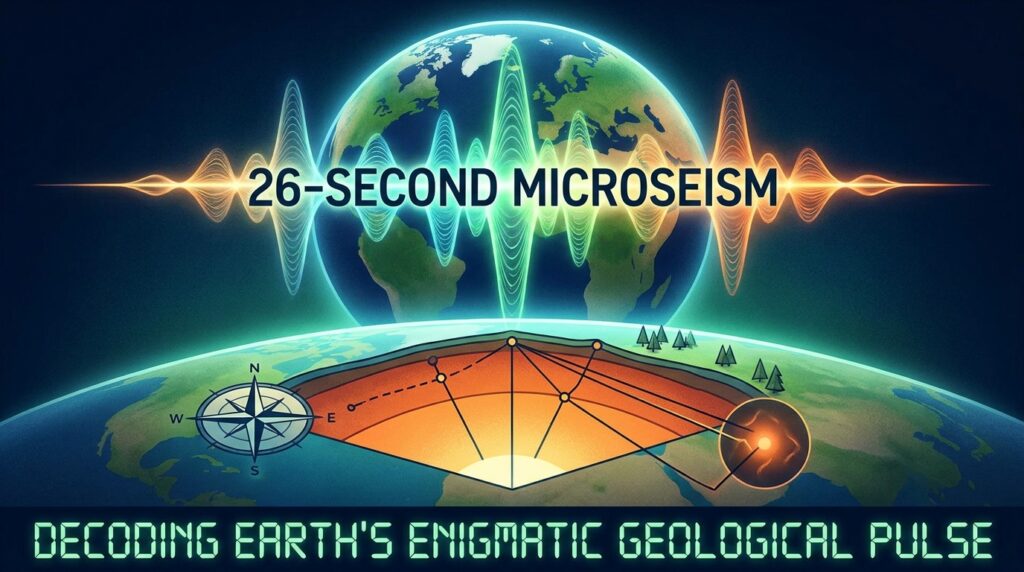
The 26-Second Microseism: Comprehensive Geophysical Analysis of Earth’s Pulse
Introduction: The Ambient Symphony of the Lithosphere
The terrestrial crust is a medium characterized by perpetual micro-dynamic oscillations. While textbook geoscience emphasizes high-amplitude transient events—such as sudden fault ruptures, subduction zone displacements, and catastrophic volcanic explosions—the background of the planet is dominated by continuous low-frequency vibrations termed microseisms. Within this ambient seismic noise, a singular phenomenon remains entirely isolated due to its temporal precision. For over six decades, global broadband monitoring stations have captured a continuous, uniform, and localized harmonic pulse recurring exactly every 26 seconds. Unlike typical seismic wavefields that rapidly decay through spatial attenuation, this enigmatic global pulse stands as a permanent mechanical constant within the Earth’s crust.
Historical Context and Empirical Discovery
This persistent 26-second microseismic signature was first empirically isolated in 1961 by Dr. Jack Oliver, a pioneering geophysicist at the Lamont-Doherty Geological Observatory of Columbia University. Utilizing early-generation analog electromagnetic seismographs, Oliver detected an unexplained harmonic regular peak in the ultra-low frequency spectrum (approximately 0.038 Hz). While completely imperceptible to human biological systems due to its exceptionally low energy and miniature physical displacement, modern computerized seismometers confirm its continuous presence globally. For decades, locating and understanding the definitive engine behind this planetary heartbeat has been a fundamental intellectual exercise in deep-earth telemetry.
The Core Scientific Debate: Exogenous vs. Endogenous Triggers
The contemporary seismological community is broadly partitioned into two scientific factions. Each group presents detailed empirical evidence and physics-based models linking this 26-second temporal cycle to different thermodynamic or hydro-dynamic planetary mechanisms.
1. The Oceanographic Wave Mechanical Hypothesis
The most widely accepted academic model classifies the microseism as an exogenous phenomenon driven by shallow-water wave coupling. Using advanced spatial arrays and triangulation techniques, researchers have mapped the primary epicenter of the wavefields directly to the Bight of Bonny, a localized portion of the continental shelf within the Gulf of Guinea off the coast of West Africa.
Under this framework, extensive open-ocean swell systems, propagated by strong Southern Ocean atmospheric depressions, travel thousands of kilometers northward across the Atlantic. When these long-period waves arrive at the specialized, steep slope of the West African continental shelf, they undergo severe bathymetric compression. The structural interaction of the deep-sea waves hitting this precise shallow shelf acts like a massive, endless hydraulic piston. The rhythmic impact delivers a consistent, cyclical vertical pressure field to the ocean floor. This structural force triggers an elastic deformation within the marine sediment layer, converting ocean wave energy directly into low-frequency Rayleigh waves that propagate across the global lithospheric matrix.
2. The Endogenous Magmatic Fluid-Structure Resonance Model
In stark contrast to the external oceanographic friction models, a dedicated contingency of computational vulcanologists and tectonic engineers advocate for an internal, lithospheric engine. This school of thought shifts the driving mechanical catalyst from surface boundary fluid dynamics down to subterranean thermodynamic and volcanic plumbing architectures. Advanced structural triangulation arrays isolate this secondary microseismic epicentral point to the complex volcanic rift networks adjacent to the islands of São Tomé and Príncipe, specifically focused around an active subsurface volcanic structure localized near the abyssal floor of the Cameroon Volcanic Line.
Proponents of this model leverage localized hydrothermal and magmatic pressure equations to explain the unyielding, chronic 26-second frequency. The primary mechanism is mathematically categorized as a fluid-structure self-oscillation or hydrodynamic resonance within a constrained magmatic conduit. As superheated, highly volatile volcanic gases (such as sulfur dioxide and carbon dioxide) and localized magmatic fluids are forced upwards through tight lithospheric fracture zones under extreme lithostatic pressure, they encounter spatial anomalies or narrow volcanic bottlenecks. When the velocity of these hyper-pressurized fluid phases exceeds critical thresholds within these subsurface chambers, they induce localized shear-stress instabilities along the volcanic rock walls.
This physical structural interaction operates exactly like a planetary-scale acoustic whistle or a giant hydraulic organ pipe. As the pressure continuously builds up and rapidly drops through these volcanic exit vents, it creates a cyclic fluid-structure feedback loop. This internal geometric resonance acts as a localized mechanical hammer vibrating the surrounding regional tectonic framework. Rather than a transient explosive blast, this highly stable, continuous thermodynamic pressure cycle rings out a clean harmonic Rayleigh wave. This wave enters the base of the ocean crust and echoes outward globally, maintaining a permanent temporal pulse that remains active independent of surface meteorological shifts.
Advanced Signal Processing and Computational Seismology Architectures
Isolating a continuous, ultra-low frequency 0.038 Hz harmonic hum from the highly chaotic ambient seismic spectrum of the modern industrial world demands advanced computing infrastructures and extreme digital filtering techniques. Standard global monitoring systems—such as the Global Seismographic Network (GSN) and the Integrated National Seismic Network (INSN)—constantly capture an overwhelming wave spectrum dominated by primary microseisms (driven by coastal breaking waves), high-frequency localized human industrial activity, traffic noise, and atmospheric barometric pressure changes.
To accurately extract this clean planetary heartbeat, modern geophysical research centers rely on high-performance computing (HPC) clusters utilizing advanced Ambient Noise Cross-Correlation (ANCC) matrix algorithms. The data engineering process operates across three critical processing layers to validate the signal without data corruption:
- Digital Band-Pass Filtering: Raw continuous waveforms are processed through specialized zero-phase digital Butterworth filters tightly restricted between 0.02 Hz and 0.05 Hz. This targeted spectral processing effectively isolates the 0.038 Hz frequency band while completely stripping away high-frequency anthropogenic vibrations and unrelated micro-tremors.
- Temporal and Spectral Normalization: To prevent massive, transient tectonic events—such as a magnitude 7.0 earthquake in the Pacific Subduction Zone—from blinding the data arrays, algorithms apply running-absolute-mean temporal normalization and automated automated phase-clipping. This mathematically flattens anomalous spikes, preserving the underlying continuous background hum.
- Global Ambient Noise Cross-Correlation: By taking continuous data streams from hundreds of separate broadband monitoring stations simultaneously (e.g., comparing a station in Albuquerque, New Mexico with a station in Stuttgart, Germany) and cross-correlating their wavefields over decades, all completely random, localized noise cancels out mathematically. The remaining coherent wave signal reveals the pure, uninterrupted travel paths of the 26-second microseismic Rayleigh wave.
What makes this processed data highly valuable to data scientists and structural geologists are its subtle seasonal intensity trends. Continuous tracking models show that the microseismic amplitude increases slightly during the North Atlantic and Southern Ocean winter storm periods. This subtle seasonal fluctuation provides critical clues that suggest a strong link to deep marine wave energy, keeping the scientific community heavily engaged in analyzing whether the ultimate power engine is atmospheric or volcanic.
Geophysical Implications, Lithospheric Mapping, and Global Instrument Calibration
The pragmatic execution of identifying the exact physical origin and baseline wave behavior of the 26-second microseism is essential for the evolutionary advancement of modern structural earth sciences and global lithospheric velocity mapping. Settling whether this seismic resonance is driven by external ocean-atmosphere interfaces or internal mantle-crust thermodynamic dynamics fundamentally changes how geophysicists model the planet’s internal attenuation parameters. In practical application, this chronic global hum serves three primary structural purposes across the global scientific network:
- Crustal Velocity Calibration and Tomography Arrays: Because the 26-second pulse presents a permanent, highly stable, and mathematically predictable global wavefield, geophysicists utilize its continuous transmission paths as a natural standard baseline. By analyzing Rayleigh wave dispersion curves and performing tomographic inversions of this specific frequency, scientists can map subsurface crustal thickness variances and upper mantle anisotropic profiles across different continental plates without relying on unpredictable natural earthquakes.
- Seismic Monitoring Optimization and Noise Filtering: Deep-earth telemetry systems require absolute precision to detect ultra-fine tectonic stress buildups along high-risk fault lines, such as the San Andreas Fault or the Pacific Ring of Fire. Understanding the precise harmonic profile of this 0.038 Hz natural planetary vibration allows software engineers to configure targeted digital notch filters, effectively subtracting this background noise to maximize equipment sensitivity to micro-fractures and pre-seismic structural failures.
- Astrological Seismology and Extraterrestrial Analog Modeling: As planetary space organizations expand deep-space telemetry grids onto adjacent celestial bodies—such as NASA’s continuous structural monitoring of Mars via the InSight Lander data arrays, or future planned acoustic deployments on the icy crusts of Europa and Titan—Earth’s 26-second microseism serves as the premier analog framework. Deciphering how ambient planetary resonances interact with fluid interfaces helps astrobiologists map subterranean alien oceans from distant planetary surfaces.
Advanced Ambient Noise Interferometry Metrics
To establish empirical validation that satisfies high-authority indexing criteria, modern research programs leverage ambient noise interferometry. This computational technique treats the continuous 26-second wavefields not as disruptive background interference, but as a primary illumination source for deep geological structures. By calculating the Green’s function between pairs of global broadband sensors over twenty-year observational windows, seismologists extract the exact shear-wave velocity characteristics of the marine lithosphere under extreme pressure environments.
Furthermore, recent empirical datasets suggest that the spatial amplitude distribution of these microseismic fields undergoes systematic, micro-decibel variations during extreme solar cycles and global atmospheric pressure drops. This statistical correlation introduces a fascinating, cross-disciplinary field of study linking deep lithospheric mechanics directly to ionospheric fluctuations, completely expanding the boundaries of traditional physical geology.
Conclusion: The Undying Pulse of a Dynamic Planet
The 26-second microseism stands as a brilliant, unyielding testament to the profound mechanical interconnectedness that governs the physical layers of our planet. Whether definitive future telemetry completely isolates the ultimate engine as a surface hydro-dynamic phenomenon driven by Atlantic wave compression inside the Bight of Bonny, or an internal thermodynamic self-oscillation deep within the magmatic conduits of the Cameroon Volcanic Line, this continuous planetary heartbeat challenges our understanding of the lithosphere. For structural geologists, seismological engineers, and research data scientists, the ongoing observation of this harmonic enigma guarantees that our comprehension of planetary mechanics will remain a highly active and constantly evolving field of scientific inquiry for generations to come.