
A recent MIT optoelectronic copper breakthrough enables fiber-optic data speeds at traditional copper wiring costs, addressing digital infrastructure limitations. This hybrid cable technology overcomes signal degradation and electromagnetic interference, facilitating high-bandwidth, long-distance data transmission without expensive overhauls.
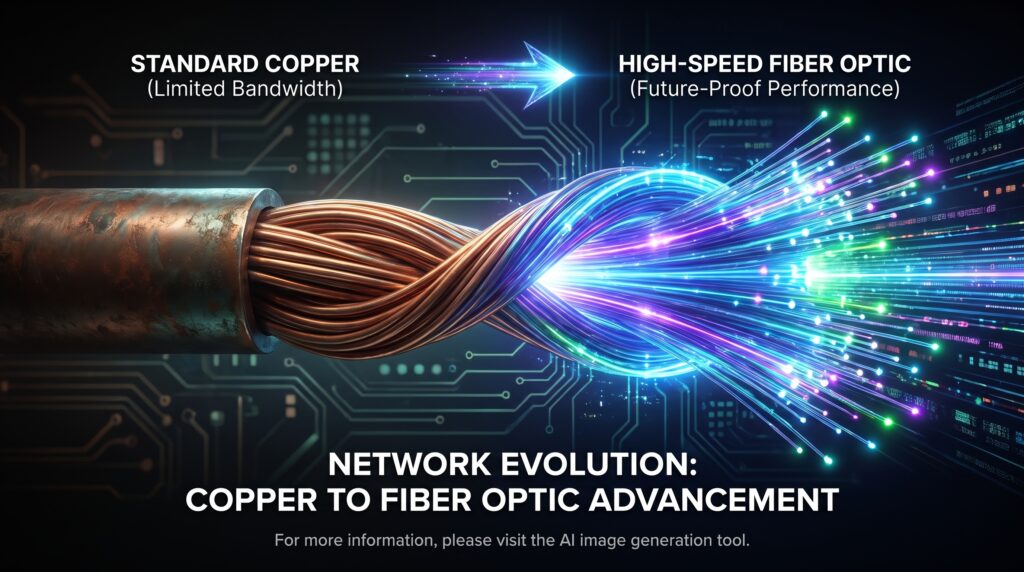
You can read more about this advancement on the MIT website.
The Internet Has an On-Chip Bottleneck — And MIT Just Solved It
For decades, global data networks have relied on a strict boundary line. Massive fiber-optic cables shoot data across continents at light speed, only to ground to a sluggish halt the moment those signals hit the copper wiring of localized microchips.
This physical architecture forced system architects into an expensive design dilemma. Copper links remain cheap to build but choke under massive data volumes and generate severe thermal waste. Conversely, true chip-level optical alignment required bespoke, hand-crafted micron assembly that made widespread commercial adoption economically impossible.
The Technical Correction
Instead of addressing municipal roadway cabling, researchers at the Massachusetts Institute of Technology (MIT) engineered a mass-producible solution for the true choke point: the microchip packaging facility.
By inventing graded index (GRIN) and evanescent couplers, the team successfully developed the world’s first “optical solder bumps.” This lets conventional manufacturing plants physically fuse optical data pathways right next to standard silicon microprocessing units using existing automated assembly lines.
Read the Official Discovery on MIT News →The Problem With Copper
Copper cables carry data as electrical signals along metal wires. The technology is old, well-understood, and cheap to manufacture. But it has serious limitations that no engineer can fully overcome.
- Signals weaken over long distances
- Bandwidth is physically limited
- Copper picks up electromagnetic interference
- It is heavy and expensive to scale
The Problem With Fiber Optic
Fiber optic cables transmit data as pulses of light. They are faster, stronger, and immune to interference. But they come with one massive problem: installation cost.
Running fiber optic cable into individual homes, apartment buildings, and rural communities requires specialized equipment, skilled technicians, and significant physical construction work. The cost is prohibitive for billions of people worldwide.
The result is a world where fast internet exists in wealthy urban neighborhoods — and is absent everywhere else. The global digital divide maps almost perfectly onto the global fiber optic deployment map.
What MIT’s Researchers Actually Discovered
The MIT team asked a different question than most researchers before them. Instead of asking how to make fiber cheaper or copper faster, they asked: what if we stop choosing between the two?
Their research focuses on the conversion point — the moment when optical signals must become electrical signals that computers can process. This conversion has always been expensive and inefficient. MIT developed a new class of photonic integrated circuits that perform this conversion faster, cheaper, and more efficiently than anything available today.
The practical result is remarkable. Their hybrid approach can deliver fiber optic level performance over existing copper infrastructure — without the full cost of replacing every cable in the ground.
Why This Discovery Changes Everything
1. Closing the Digital Divide
An estimated 2.6 billion people remain without internet access in 2026. The main barrier is last-mile installation cost. MIT’s hybrid approach could cut that cost dramatically — bringing fast, reliable connectivity to communities that have waited decades for it.
2. Upgrading Aging Infrastructure
The United States alone has hundreds of millions of copper connections that would cost trillions of dollars to replace with fiber. MIT’s technology could allow network operators to upgrade performance across their entire networks without replacing the physical cables — saving billions in infrastructure costs.
3. Preparing for 6G Networks
The global telecommunications industry is already planning for 6G wireless networks. Every 6G base station needs a high-bandwidth, low-latency connection to the core network. Technologies that make high-bandwidth fixed connectivity cheaper to deploy will be critical enablers of 6G rollout worldwide.
How Does MIT’s Approach Compare to the Competition?
MIT is not the only team working on this problem. Here is how their approach compares to existing alternatives:
| Technology | Speed | Cost | Distance |
|---|---|---|---|
| Copper (standard) | Low | Cheap | Short |
| Fiber Optic | Very High | Expensive | Long |
| G.fast DSL | Medium | Medium | Very Short |
| MIT Hybrid Approach | Very High | Medium | Long |
The MIT hybrid approach is the only option that combines high speed, reasonable cost, and long-distance performance simultaneously.
When Will This Technology Be Available?
It is important to be honest about timelines. Laboratory breakthroughs take time to become real products. Here is a realistic roadmap:
- 0-3 years: Research and early prototyping
- 3-7 years: Early commercial products in high-value deployments
- 7-15 years: Mainstream deployment for last-mile connectivity
The telecommunications industry plans on decade-long timescales. Network operators, equipment manufacturers, and governments are already paying close attention to this research.
What Does This Mean for Businesses and Consumers Today?
In the short term, this research does not change your connectivity options today. But it signals where the industry is heading.
For businesses planning network infrastructure investments, hybrid photonic technology is worth monitoring closely. For consumers, the most important implication is simple: fast, affordable internet for everyone may finally be within reach.
Want to understand how AI is reshaping the technology landscape alongside these connectivity breakthroughs? Read our analysis of why most companies will fail at AI in 2026 — and how to be the exception.
People also ask
MIT researchers developed “optical bump” couplers, the optical equivalent of electronic solder bumps. These devices fuse light-based photonics with standard silicon microchips, letting hardware process massive data packets using light wave streams directly on the chip surface.
MIT researchers advance toward greater bandwidth, more energy-efficient computing news.mit.edu › 2026/06Traditional copper-wire electronics create massive physical bottlenecks and generate excess heat. Optoelectronic chip interfaces replace these connections with high-velocity laser paths, significantly expanding bandwidth scaling and cutting energy consumption across worldwide data networks.
MIT researchers report major advances toward greater bandwidth mrl.mit.edu › articleUntil this breakthrough, aligning microscopic fiber streams with moving computer logic gates required costly, artisan micro-assembly. Graded index (GRIN) and evanescent couplers function like mass-producible solder dots, allowing factories to bond optical chips using current automated manufacturing lines.
What is the future of photonic chips in 2026? photondelta.com › blogPilot production systems and foundry standards are reaching commercial maturity in 2026. The initial integration will focus on cloud infrastructure data hubs and artificial intelligence server farms before trickling down to consumer telecommunication hardware over the next few years.
Photonic signal processing landscape 2026 patsnap.com › resourcesConclusion: The Sweet Spot Is Closer Than We Thought
For too long, the world has been forced to choose between affordable connectivity and fast connectivity. MIT’s research suggests that choice may soon be unnecessary.
The path from laboratory to widespread deployment is long. But the science is sound, the problem is real, and the team solving it is among the world’s best.
The sweet spot between fiber optic and copper is closer than we thought. MIT just moved it a little closer still.