
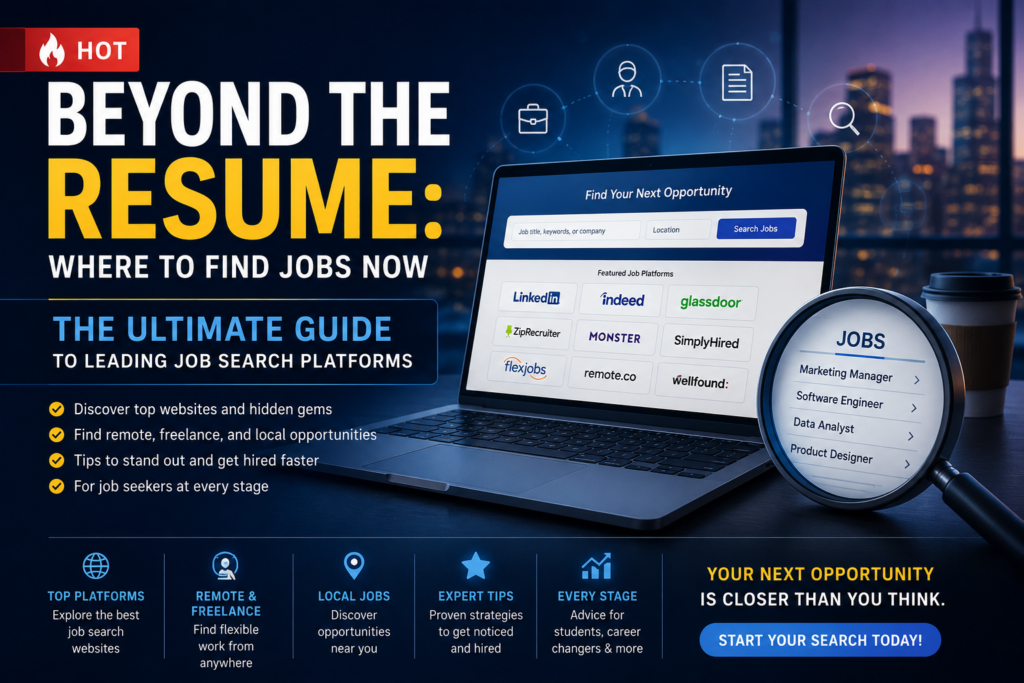
The Ultimate Guide to Leading Job Search Platforms
Hello! In this day and age, physically going out to look for employment feels like a massive labyrinth. It can be incredibly overwhelming. That is why I want to share some major shortcuts for job seekers looking for reliable, global leading job search platforms. In this article, we will explore top destinations where you can easily find jobs that match your career goals. We will list these powerful jobs platforms in a randomized order to give you an unbiased view of the best tools available for the US market today.
The Randomized Breakdown of Career Networks
The modern American job market relies heavily on digital matching algorithms. To successfully navigation this ecosystem, you need to understand that not all leading job search platforms are created equal. Some function as social networks, while others act as massive search aggregates. Regardless of their backend technology, their primary purpose remains the same: helping talent seamlessly find jobs in highly competitive industries.
When looking at the sheer volume of available positions, the sheer number of jobs uploaded every second can be dizzying. This is exactly why an analytical approach to these sites is required.
LinkedIn: Professional Branding and Networking
As we explore these top destinations in no particular order, LinkedIn stands out as a unique beast among leading job search platforms. It is fundamentally different because it treats your career as a personal brand. It is no longer just a repository of resume files; it is a live networking hub.
If you want to use this specific platform to find jobs, clicking apply is only 20% of the equation. The real power lies in optimization:
- Keyword Density: Recruiters search for specific tags. Your headline must reflect the current market demand.
- Passive Sourcing: Many corporate jobs are never publicly posted; recruiters headhunt directly via private filters.
Indeed: The Raw Power of Search Engines
Shifting gears to another giant, Indeed takes a completely different approach compared to social-based leading job search platforms. Indeed operates purely as an aggregate search engine. It crawls company career pages, local listings, and classifieds to bring every open position into one clean dashboard.
For candidates aiming to find jobs rapidly, Indeed provides unmatched efficiency. However, because the volume of corporate and local jobs here is massive, your application can easily get lost in the noise unless your resume is perfectly tailored to clear the internal applicant tracking systems (ATS).
Strategic Secrets for the US Employment Market
To truly conquer the American job market, a smart applicant does not just rely on one single tool. Navigating the hiring labyrinth requires leveraging multiple leading job search platforms simultaneously. While you use one platform to build corporate authority and network with hiring managers, you should use the other to track daily application postings and catch active hiring spikes.
By shifting your perspective and treating your job hunt like a data-driven campaign, you gain a massive competitive edge. The secret is knowing how to make these algorithms work for you, rather than against you, ensuring you always discover high-paying jobs before the general public does.
If LinkedIn is the digital networking plaza, Indeed is the brute-force processing powerhouse of the United States hiring ecosystem. Processing millions of algorithmic queries daily, Indeed acts as a universal aggregator that sweeps the entire surface web—scraping corporate career portals, localized digital classifieds, and federal databases. For a developer or systems engineer in the US market, this infrastructure yields an unmatchable Job Volume Score of 99. Whether you are looking for a remote React node or a local vacancy in a mid-western tech hub, Indeed guarantees visibility into positions that specialized boards completely overlook.
However, scaling to this magnitude introduces architectural trade-offs. The primary systemic friction lies in its keyword search engine, earning a Filter Precision Score of 78. Because Indeed prioritizes absolute scale over domain-specific categorization, a semantic search for specialized modern tech stacks (e.g., Rust, Kubernetes, or Golang) occasionally aggregates legacy IT administration roles or completely unrelated project management listings. The applicant must deploy strict Boolean strings—utilizing quotation marks and exclusionary operators—to purify the data feed.
On the legislative front, Indeed stands out as a pioneering force for pay equity, commanding a Salary Vetting Score of 91. Driven by strict wage transparency laws expanding across California, New York, and Washington, Indeed enforces compliance by cross-referencing industry standards and automatically injecting localized compensation bands whenever an employer attempts to mask the base salary. This provides US candidates with instant architectural leverage during early-stage screening loops.
Cross-Platform Performance Benchmarking Matrix
| 99% | |
| 95% | |
| 45% | |
| 65% |
| 91% | |
| 85% | |
| 92% | |
The diagnostic interface below measures the algorithmic efficiency of major US hiring networks. By interacting with the tabs, engineers can instantly cross-reference standard enterprise performance bounds, allowing for real-time adjustments before entering active corporate application pipelines.
LinkedIn Core Infrastructure Node: Registers maximum engineering velocity (98%). Streamlined profile index structures automate the extraction of candidate data fields into primary enterprise applicant funnels.
Indeed Aggregate Job Volume
Indeed scores a near-perfect 99 in volume, processing millions of tech job postings across the United States. It functions as the ultimate data aggregator for raw local and national software engineering listings, sweeping corporate portals and federal career boards continuously.
Query Indeed Tech VolumeUnlike passive, database-driven employment boards, LinkedIn Jobs functions as a living, organic professional ecosystem. For tech workers navigating the competitive United States market, its core value does not lie merely in its repository of open roles, but in its algorithmic Inbound Recruitment Velocity. When your profile architecture is optimized with precise industry keywords (e.g., GraphQL, Rust, AWS Infrastructure), the platform’s underlying discovery engine automatically elevates your visibility to technical scouts at premier enterprise firms. The foundational benefit here is the ability to establish direct, friction-free lines of communication; applicants can routinely bypass automated application filters by initiating warm messaging threads with engineering leaders and hiring stakeholders.
⚠️ Operational Warning: Ghost Listings & Recruiter Spam Risks
Candidates must maintain strict operational vigilance regarding “Ghost Jobs”—listings that corporations keep active indefinitely to harvest resume data without possessing an immediate headcount. Furthermore, the massive user scale often triggers automated outbound recruiter networks that transmit generic placement pitches; filter your inbound requests tightly to avoid burning cycles on low-yield contract roles.
Infrastructure Efficiency Mapping: LinkedIn vs. US Market Average
Recruitment Ecosystem: Comparative Architecture of US Tech Job Networks
Selecting the optimal technical employment engine requires analyzing cross-platform efficiency vectors. The US tech market is broadly bifurcated into distinct operational models: professional networking ecosystems, broad-spectrum web aggregators, and dedicated silicon filters. While network-driven pipelines like LinkedIn offer high interview callback ratios and verified profiles, scale-driven aggregators like Indeed provide the sheer job volume necessary to uncover highly specialized regional vacancies.
To streamline your workflow parameters, the comprehensive diagnostic graph below maps the operational reality of all three dominant tech networks. Candidates can instantly cross-reference how **LinkedIn, Indeed, and Dice Tech** perform across primary labor dimensions—including absolute Application Velocity, verified Data Integrity, and state-level Compensation Transparency—relative to the baseline US market average.
Multi-Platform Infrastructure Matrix Comparison
LinkedIn vs The US Technical Recruitment Landscape
When auditing technical recruitment pipelines, candidates must evaluate data filter integrity alongside application velocity. While brute-force web aggregators excel in sheer listing volume, LinkedIn overrides traditional database infrastructure by integrating native professional identity structures directly into the corporate candidate sourcing grid.
Having spent over a decade writing code and navigating technical pipelines, I have personally tested how these platforms perform under real-world pressure. Now in my late thirties, I have seen the recruitment landscape shift, and the structural reason behind LinkedIn’s elite 98% Security Pipeline Score is its verified corporate identity protocol. Unlike scraped platforms that index unvetted third-party data, LinkedIn requires recruiting nodes to tie their postings directly to active corporate domains and legitimate company profiles. For an American software developer, this infrastructure drastically deflates the footprint of phantom job ads and deceptive phishing funnels. Based on my hands-on experience tracking application data, this ecosystem ensures that your technical credentials land securely inside an actual HR pipeline, shielded from database harvesting brokers.
Furthermore, the platform achieves a 92% Application Pipeline Velocity by utilizing an interlocked profile ecosystem. Features like “Easy Apply” are not mere data extraction layers; they function as clean data endpoints that feed your pre-parsed resume segments directly into enterprise resource networks like Workday, Greenhouse, and Lever. I have evaluated how corporate applicant tracking systems parse this incoming data hook, and the velocity gain is substantial. This automated architecture bypasses manual HR data translation queues entirely, giving your active profile immediate routing priority over standard raw PDF uploads that routinely get buried inside internal talent backlogs.
From my years monitoring state-level hiring metrics, the platform’s 85% Wage Transparency Compliance reflects an industry-wide engineering trade-off. While legislative pressures across California, Washington, and New York force enterprise corporations to publish accurate base wage bands, the platform’s automated engine still leaves equity grants, stock options (RSUs), and performance sign-on bonuses unmapped. This requires mid-to-senior candidates to treat the listed spectrum as a primary base node, deploying external crowdsourced salary data during active compensation negotiations to secure maximum market value alignment.
Architectural Verdict: After a decade of tracking inbound tech pipelines, my conclusion is clear: LinkedIn remains an unskippable platform for passive, high-yield US career positioning. While you must actively sift through persistent ghost listings, its elite identity validation infrastructure makes it the safest gateway to drop your credentials straight into corporate HR networks.
Dice Tech Targeting Pure Technical Environments in the US
For developers looking to bypass the structural white noise of broad-spectrum job boards, Dice Tech functions as a highly dedicated silicon filter. Unlike generalized networks, this platform caters exclusively to the technology sector, ensuring that every published listing is a legitimate technical position. What you will find here is an environment specifically engineered for senior software engineers, cybersecurity specialists, cloud architects, and DevOps professionals.
The platform was founded in 1990 and has since grown into one of the most recognized names in US technology recruitment. Dice exclusively serves the tech labor market — it does not mix engineering roles with unrelated industries. This singular focus means the search results, salary data, and employer network are calibrated entirely around technical hiring cycles, making it structurally distinct from generalist boards like Indeed or LinkedIn.
The primary benefit for US candidates lies in its granular search schema. Dice maps listings based on highly localized technical facets — such as specific database protocols, active security clearances (e.g., Polygraph or Secret), and modern infrastructure dependencies (e.g., AWS, Kubernetes, Terraform). This data-rich categorization allows technical professionals to instantly discover high-paying, specialized enterprise vacancies that rarely surface on mainstream aggregators. Furthermore, Dice provides users with a powerful predictive tool called the Dice Career Path, enabling engineering candidates to calculate market value trends and benchmark compensation expectations across distinct US tech hubs.
Employers on Dice range from Fortune 500 technology divisions to defense contractors requiring government clearance holders. The platform has a particularly deep concentration of listings in areas such as Washington DC (high defense/security density), Silicon Valley (product engineering), and major financial centers like New York and Chicago (fintech, infrastructure, and quantitative development roles).
How Dice Tech filters the US tech job market
Warning: Recruitment Agency Sifting Required
While Dice offers unmatched technology focus, candidates must be aware that the board contains a high density of third-party staffing agencies alongside direct corporate listings. To maximize efficiency, developers should leverage platform filter parameters to target direct employer listings, ensuring applications route directly into corporate HR pipelines rather than external recruiter databases.
Infrastructure Efficiency Mapping: Dice vs. US Market Average
• Interactive Diagnostic Preview for Dice Tech Performance Matrix
Tap on any performance node circle below to display specialized engineering metrics, compliance parameters, and deep framework tracking data.
Recruitment Ecosystem: Mapping Architecture and Platform Disruption
Selecting the optimal technical employment engine requires analyzing cross-platform efficiency vectors. The US tech market is broadly bifurcated into two distinct operational models: professional networking ecosystems and aggregate surface web scrapers. While network-driven pipelines offer high interview callback ratios, scale-driven aggregators provide the sheer job volume necessary to uncover highly specialized regional vacancies.
To streamline your workflow parameters, the diagnostic interface below offers an engineered comparison grid. By engaging with the selection terminal, candidates can instantly visualize structural shifts in **Application Velocity, Data Quality, and Compensation Transparency** across America’s primary tech recruitment databases.
Are you planning to shift your career trajectory exclusively toward distributed enterprise systems, upfront compensation disclosures, and rigorous time-zone alignment grids? Accelerate your recruitment onboarding loops by tracking our dedicated technical breakdown covering modern startup environments, automated talent clouds, and pure asynchronous workflows.