
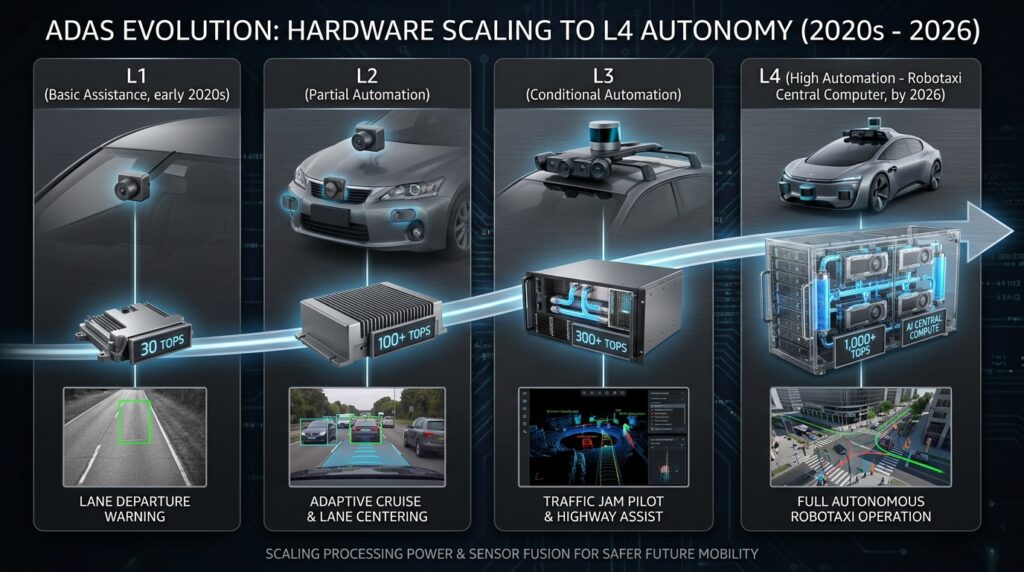
By 2026, the SAE J3016 ADAS autopilot taxonomy is directly dictated by System-on-Chip (SoC) hardware scaling. Vehicle engineering has evolved from 2 TOPS microcontrollers managing simple Level 1 lane-keeping systems to centralized 1,000+ TOPS computing platforms powering Level 4 robotaxi fleets. This progression replaces isolated vehicle electronic control units (ECUs) with unified, high-performance architectures built to process complex, multi-modal sensor fusion in real time.
ADAS Levels Explained: Autonomous Driving Chips and the 2026 Silicon Architecture Master Guide
The automotive and semiconductor industries have collided. By 2026, this collision defines every Software-Defined Vehicle (SDV) roadmap. Understanding ADAS levels explained autonomous driving chips is now essential reading for engineers, product managers, and technology buyers alike.
This guide breaks down the SAE J3016 automation taxonomy. It pairs each level with the System-on-Chip (SoC) architecture that makes it possible. We start with a 2 TOPS microcontroller running a Level 1 lane-keeping system. We end with 1,000+ TOPS centralized platforms now entering Level 4 robotaxi fleets.
Executive Summary & The 2026 Autonomous Driving Landscape
Three trends define ADAS in 2026. First, Level 2+ “hands-off, eyes-on” systems are now mainstream. Second, premium OEMs are rolling out Level 3 conditional automation in narrow, certified zones. Third, Level 4 robotaxi platforms are scaling from pilots to industrial deployment.
Mercedes-Benz’s Drive Pilot remains the benchmark for certified Level 3 traffic-jam driving. BMW and other German automakers are following, validated under UNECE Regulation 157.
On the silicon side, 2026 marks a major production ramp. NVIDIA’s DRIVE Thor platform, built on the Blackwell architecture, is now shipping in vehicles from Zeekr and BYD. Thor delivers up to 2,000 FP4 TFLOPS — roughly 1,000 INT8 TOPS. That is nearly eight times the compute density of its predecessor, DRIVE Orin (254 TOPS).
Qualcomm has expanded its Snapdragon Ride family (Flex, Elite, and Cockpit Elite). These chips compete in the mid-to-high TOPS segment. They emphasize power efficiency and built-in connectivity. Mobileye continues scaling its EyeQ6 family. The EyeQ6H now powers both Surround ADAS (L2++) programs and Chauffeur (L3) pilots with the Volkswagen Group.
The biggest 2026 milestone is a shift in strategy. The industry is moving from custom test fleets to standardized robotaxi reference architectures. The Mobileye Drive / VW ID.Buzz robotaxi ecosystem has reached pre-series production. It runs alongside Uber and MOIA. NVIDIA’s DRIVE Hyperion platform, paired with Thor, is powering a robotaxi launch in Munich with Uber and Autobrains.
This matters for one simple reason. The 1,000+ TOPS threshold for real Level 4 operation is no longer theoretical. It is now commercially viable at automotive-grade power and thermal limits. Three years ago, that was not true.
Demystifying the SAE J3016 Standard: The True Boundary Lines
Any serious discussion of autonomous driving levels must start with SAE J3016. Published and maintained by SAE International, the standard defines six levels (0–5). The core question at every level is simple: who performs the Dynamic Driving Task (DDT)? And who handles the DDT fallback if something goes wrong?
The DDT itself has a precise scope. It includes lateral control (steering) and longitudinal control (acceleration and braking). It also includes Object and Event Detection and Response (OEDR). It does not include trip planning or destination selection. This distinction matters for liability. A system that handles navigation but not real-time obstacle response is not performing the DDT under SAE’s definition.
Three concepts form the backbone of the entire taxonomy. Mixing them up is the most common error in public discussions of self-driving cars.
Driver Support Features (Levels 0–2): A human driver always performs part of the DDT here. The human is always responsible for OEDR and fallback. This holds true even during “hands-off” driving. The system supports the driver. It never replaces the driver.
Automated Driving Features / ADS (Levels 3–5): An Automated Driving System performs the entire DDT. This happens within a defined Operational Design Domain (ODD). Below the L2/L3 line, the human is the fallback. At and above it, within the ODD, the ADS becomes the fallback.
Operational Design Domain (ODD): This is the most misunderstood concept in J3016. An ODD is not a simple on/off switch. It is a multidimensional envelope: geography, road type, speed range, weather, and time of day. A Level 4 system with a highway-only, daytime, clear-weather ODD has no extra capability outside that envelope. Outside it, the system is effectively Level 2 — or simply off.
One more clarification matters. J3016 is not a performance standard. It does not specify required sensors or compute power. It makes no claim about whether a system is “safe enough.” Those questions belong to ISO 26262 and ISO 21448 (SOTIF), covered later in this guide. J3016 is a shared vocabulary — nothing more, nothing less. It also treats automation level as a property of the feature, not the vehicle. A single car can have an L2 highway feature and an L3 traffic-jam feature at the same time. Each has its own ODD and its own fallback rules.
Granular Deep Dive: Level 0 to Level 5 Breakdown
Level 0: No Driving Automation
Level 0 is the baseline. But it does not mean “no technology.” Modern Level 0 vehicles are full of sensors and chips. They simply do not use that compute to sustain control of the car. Under J3016, Level 0 covers systems that give momentary or warning-only output. This includes Automatic Emergency Braking (AEB), Forward Collision Warning (FCW), Lane Departure Warning (LDW), and Blind Spot Warning (BSW). AEB physically applies the brakes. But it is still Level 0, because the action is momentary and reactive.
Liability vs. fallback: At Level 0, the human driver performs 100% of the DDT. This includes steering, acceleration, braking, and OEDR — continuously, with no exceptions. There is no “fallback” concept here. There is no automated feature to fail. Warning systems sit beneath an entirely human-driven task. From an insurance standpoint, Level 0 incidents are assessed under normal human-driver liability. AEB and similar systems affect product-liability and crash-rating scores, not automation liability.
Minimum sensor suite: Even at this level, sensors are substantial. A typical 2026 Level 0 vehicle includes one forward camera (mono or stereo) for lane and sign detection. It also includes one or two forward radars (77 GHz) for FCW and AEB. Add four to twelve ultrasonic sensors for parking. Many markets also require a driver-monitoring camera, driven by regulations like the EU’s General Safety Regulation. Processing runs on automotive microcontrollers from NXP, Renesas, or Infineon. Compute demand stays under 1–2 TOPS — often measured in GOPS, not TOPS. Priority goes to ASIL-D safety certification, not raw AI throughput.
Level 1: Driver Assistance
Level 1 brings the first true “automation” under J3016. But the constraint is strict. A Level 1 system can sustain automation of either the lateral or the longitudinal task — never both at once. Adaptive Cruise Control (ACC) is the classic longitudinal example. It manages following distance and speed. Lane Centering Assist (LCA) is the classic lateral example. It keeps the car centered in its lane. A car can offer both. But if they don’t run together as one system, the car is still Level 1 — just with two separate Level 1 features.
Liability vs. fallback: The human driver keeps full responsibility for the DDT and OEDR. The system runs one sustained subtask. But the driver must supervise both that subtask and the one the system doesn’t handle. If ACC is active, the driver must still steer continuously. The driver remains the only fallback for any system limit — like a stationary object after a curve, a known weakness of early radar-only ACC. Legally, Level 1 features are conveniences. They shift zero liability away from the human operator. Courts treat Level 1 activation as irrelevant to fault.
Minimum sensor suite: Level 1 builds on Level 0’s foundation. For ACC, the key addition is a stronger forward radar. It’s often fused with a forward camera, tracking multiple vehicles up to 150–200 meters. For Lane Centering, a forward camera becomes mandatory. It must detect lane markings reliably across lighting and weather. This is usually a single camera near the rearview mirror, typically 1–2 megapixels. Compute rises modestly to 2–10 TOPS. SoCs like the TI TDA4VL/VM family or entry-level Mobileye EyeQ chips handle this. The focus stays on deterministic, certified processing — not general neural-network throughput.
Level 2: Partial Driving Automation
Level 2 is the most commercially important level in 2026. It’s also the most misunderstood. The system performs sustained lateral AND longitudinal control at the same time. ACC and lane centering combine into one feature. This is often branded as “highway driving assist,” “autopilot,” or “super cruise.” The hard requirement is this: the driver must continuously perform OEDR. The driver monitors the road and stays ready to intervene immediately.
Liability vs. fallback: This is where confusion causes real-world harm. Marketing language often implies “self-driving.” But Level 2 puts 100% of OEDR — and therefore 100% of liability in most jurisdictions — on the human driver. The system is a “driver support feature.” It is not an ADS. There is no ADS fallback at Level 2, because there is no ADS. The human driver is the fallback, continuously, even with hands off the wheel. That’s why every Level 2 system includes Driver Monitoring Systems (DMS). Infrared cameras track gaze and eyelid closure. They issue warnings — and disengage the system — if attention lapses.
Minimum sensor suite: Level 2 sensor suites jump in both quantity and quality. A typical 2026 L2/L2+ setup includes one or more forward cameras — often tri-focal, combining wide, narrow, and standard fields of view. It adds forward and corner radars (4–5 units total) for 360-degree near-field coverage. It includes a full ring of ultrasonic sensors and four surround-view cameras for a 360-degree visual perimeter. Critically, it adds an infrared driver-monitoring camera near the steering column or instrument cluster. Some premium “L2++” systems now add a single forward lidar for better object classification — without crossing the liability line. Compute spans 10–30 TOPS. SoCs include the Mobileye EyeQ5 (~24 TOPS), Qualcomm Snapdragon Ride SA8540P, or lower-tier NVIDIA Orin configurations.
Level 3: Conditional Driving Automation
Level 3 is the single most important threshold in J3016. Here, the Automated Driving System (ADS) takes over the entire DDT — including OEDR — within its ODD. Crucially, it also takes over DDT fallback while inside that ODD. The human shifts roles. They go from “driver” to “fallback-ready user.” They don’t need to watch the road continuously. But they must be ready to take over when the system asks — usually within a few seconds.
Liability vs. fallback: This is where liability genuinely shifts. Inside the validated ODD, the manufacturer takes responsibility for the ADS’s driving decisions. For Mercedes-Benz Drive Pilot, the ODD means specific highways, traffic-jam density, below a defined speed (originally up to 60 km/h), daylight, and clear weather. Mercedes-Benz has been explicit: if Drive Pilot is active and within its ODD, and an incident happens due to a system decision, Mercedes-Benz accepts liability. That’s a landmark in product liability. But cross any ODD boundary — speed, weather, road type, or a takeover request — and responsibility shifts back to the human. If the human fails to respond in time, liability returns to them too. This is why Level 3 rollouts stay narrow. Every ODD boundary must be validated and certified — under UNECE Regulation 157, explicitly approved.
Minimum sensor suite: At Level 3, sensor redundancy becomes mandatory, not optional. The ADS must handle its own fallback — like a controlled stop — without driver help. No single sensor can be a point of failure. A typical L3 suite includes redundant forward radars, a forward lidar (Mercedes uses a roof- or grille-mounted unit from Valeo), and a multi-camera array with overlapping coverage (often 8+ cameras). It adds surround radar, ultrasonic sensors, and high-precision localization — GPS/GNSS combined with dead-reckoning and HD-map matching for centimeter-level positioning. Redundant power, redundant compute domains (often dual SoCs in lockstep), and redundant braking/steering paths are also required. Compute spans roughly 30–254 TOPS. NVIDIA DRIVE Orin (254 TOPS) and Mobileye’s EyeQ6H represent the current production benchmark.
Level 4: High Driving Automation
Level 4 extends Level 3’s model. The ADS performs everything — and the human fallback requirement disappears, within the ODD. If the ADS hits a situation it can’t handle, or a fault occurs, the ADS itself must execute a safe fallback. This usually means pulling to the shoulder or stopping in-lane — with no human involved. In principle, a Level 4 vehicle can operate with no human occupant at all. That’s why Level 4 is the foundation for robotaxi services.
Liability vs. fallback: Inside the ODD, the ADS carries 100% of both DDT performance and fallback. There is no human in the driving-decision loop. This is the model behind Mobileye’s Drive platform, running the VW ID.Buzz robotaxi fleet with MOIA and Uber. It’s also the model behind NVIDIA’s DRIVE Hyperion/Thor platform, powering the Uber/Autobrains robotaxi launch in Munich. Liability sits with the fleet operator and/or ADS developer. This runs under a different framework than personal-vehicle liability — commercial insurance, municipal permits, and (in Europe) UNECE-aligned ADS approvals. The ODD still rules everything. A Level 4 robotaxi that works perfectly in Phoenix has zero autonomous capability outside that geofenced, weather-bounded zone. Outside the ODD, it either needs a human driver or stays parked.
Minimum sensor suite: Level 4 sensor suites are the most complete in production today. NVIDIA’s DRIVE Hyperion 10 reference architecture is the industry benchmark. It specifies 14 cameras, 9 radars, 1 lidar, and 12 ultrasonic sensors. This gives full 360-degree coverage across three independent modalities — visual, radar, and lidar — with enough overlap that losing one sensor doesn’t create a blind spot. Compute architectures match this scale: 254–1,000 TOPS, mainly served by NVIDIA DRIVE Thor (up to 1,000 INT8 TOPS per SoC, often deployed in pairs for redundancy — pushing aggregate compute toward 2,000 TOPS). Qualcomm’s Snapdragon Ride Elite and Horizon Robotics’ Journey 6 also compete here, especially in China. Memory bandwidth, thermal design (often liquid-cooled), and safety-rated power delivery become the main engineering challenges at this tier.
Level 5: Full Driving Automation
Level 5 is the theoretical top of J3016. As of mid-2026, no production vehicle has reached it. The defining trait — and the hardest part — is the removal of any ODD limit. The ADS must handle the entire DDT and fallback under any condition a competent human driver could manage. No geofencing. No weather limits. No infrastructure dependency.
Liability vs. fallback: In true Level 5, “driver” and “occupant” become separate concepts entirely. A Level 5 vehicle may have no steering wheel or pedals at all. No human is ever expected to drive it. Liability sits fully and permanently with the ADS developer, manufacturer, or fleet operator — under all circumstances. There is no human fallback path, even in theory. This is the endpoint of a liability journey that starts at the L2/L3 boundary: from zero liability shift (L2), through bounded, ODD-dependent shift (L3/L4), to total, unconditional manufacturer responsibility (L5).
Minimum sensor suite: Because Level 5 has no ODD, its sensor suite must go beyond even Level 4’s redundant, tri-modal coverage. It must handle edge cases that Level 4 ODDs simply exclude — unmapped rural roads with no lane markings, extreme weather (heavy snow, dense fog, torrential rain) that degrades cameras and lidar, off-road or unstructured terrain, and unpredictable actors like animals, debris, or emergency vehicles with no prior mapping. This likely means higher-resolution, longer-range, more weather-resilient versions of every Level 4 sensor. Expect 4D imaging radar and thermal cameras for low-visibility pedestrian detection, plus far more sophisticated fusion and redundancy. Compute is projected at 1,000–2,000+ TOPS and climbing — likely needing multiple next-generation SoCs working together. Demand is driven not just by perception, but by generalized world-model and planning capability — the NPU computing needed for true Vision-Language-Action (VLA) reasoning. No chipmaker currently markets a Level 5-certified production SoC. It remains a multi-generation silicon target, not a near-term product.
Industry Regulations, Safety Standards, and Future Trends
ISO 26262: The Functional Safety Backbone
ISO 26262 governs functional safety for road-vehicle electronics. It defines ASIL A through D — Automotive Safety Integrity Levels. Every SoC, sensor, and software block in an ADAS stack must meet the right ASIL tier. This protects against random and systematic failures. For Level 3–5 systems, the central compute platform must reach ASIL-D — the highest tier. This usually means lockstep CPU cores, error-correcting memory, and independent monitors. These monitors must detect a fault and trigger a safe state within milliseconds.
ISO 21448 (SOTIF): Safety Beyond Hardware Failure
ISO 26262 covers “what happens when something breaks.” ISO 21448 — Safety of the Intended Functionality (SOTIF) covers a harder problem. What happens when nothing breaks, but the system still makes an unsafe call? This happens because of sensor limits, algorithm limits, or training-data gaps. SOTIF governs how manufacturers find, validate, and reduce these “unknown unsafe scenarios.” This requires massive simulation, real-world data collection, and statistical validation. For Level 3+ systems, SOTIF compliance often costs more than the silicon itself.
UNECE Regulation 157 and the NHTSA Framework
In UNECE markets — the EU, Japan, Korea, and others — UNECE WP.29 Regulation 157 governs Automated Lane Keeping Systems (ALKS). It provides the formal type-approval path for Level 3 Conditional Automation. Mercedes-Benz used this regulation to certify Drive Pilot. In the United States, the NHTSA Automated Vehicles framework works differently. There is no single federal type-approval regime for ADS. Instead, the US relies on FMVSS interpretation, voluntary safety self-assessments, and state-level robotaxi permits. This regulatory split shapes where each automation level can legally run in 2026.
Future Trends: The Road Beyond 2026
Three trends define the silicon roadmap past 2026. First, chiplet-based integration is replacing single-die SoCs. NPU, CPU, and I/O blocks now sit on separate dies within one package. Each die can use the best process node for its job. Compute, memory, and I/O can scale independently. Second, Vision-Language-Action (VLA) models are becoming the planning layer. This pushes automotive NPUs toward transformer-optimized designs — smaller, power-constrained cousins of data-center AI accelerators. Third, the industry is converging on centralized, zonal compute architectures. Instead of 80–100 discrete ECUs, vehicles now use 2–4 zonal controllers feeding one central AI platform — the Thor/Hyperion model. This simplifies wiring, cuts weight and cost, and — most importantly — lets over-the-air updates meaningfully improve ADAS capability over a vehicle’s lifetime. That last point is the defining trait of the Software-Defined Vehicle era.
Conclusion: The Horizon of Autonomous Mobility in 2026
The evolution of autonomous driving through the various ADAS levels is fundamentally reshaping our relationship with transportation. Transitioning from basic driver assistance to fully autonomous ecosystems is no longer a distant theoretical vision — it is an ongoing engineering reality powered by hyper-scalable silicon architectures and sophisticated NPUs.
As we progress through 2026 and look toward the future, the ultimate success of autonomous mobility will depend on the seamless fusion of hardware reliability, robust regulatory compliance, and uncompromised cybersecurity protocols. For consumers, this technological shift promises not only greater convenience on the road but a monumental leap forward in global vehicle safety. The software-defined vehicle has officially arrived, and it is permanently rewriting the rules of the automotive industry.