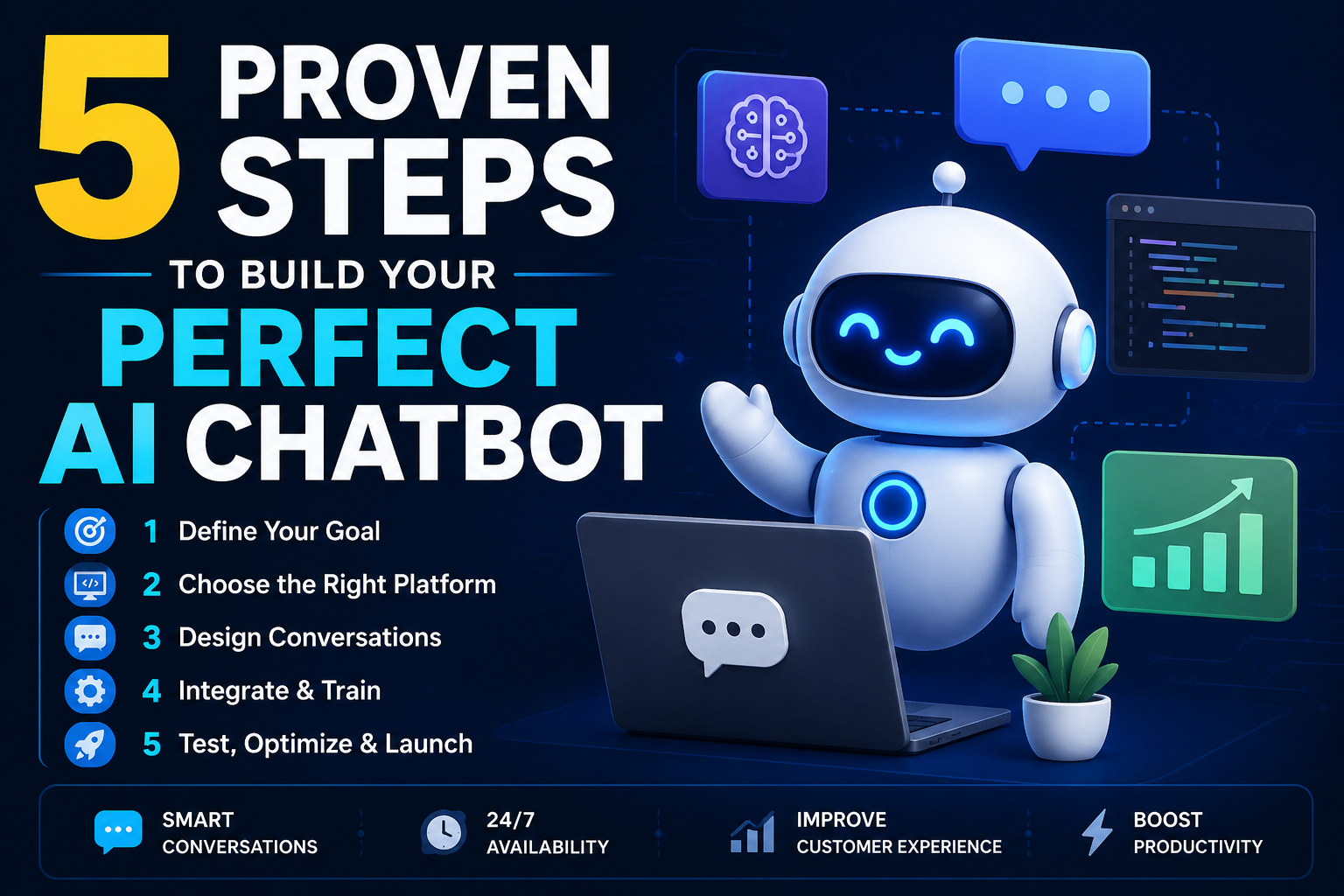
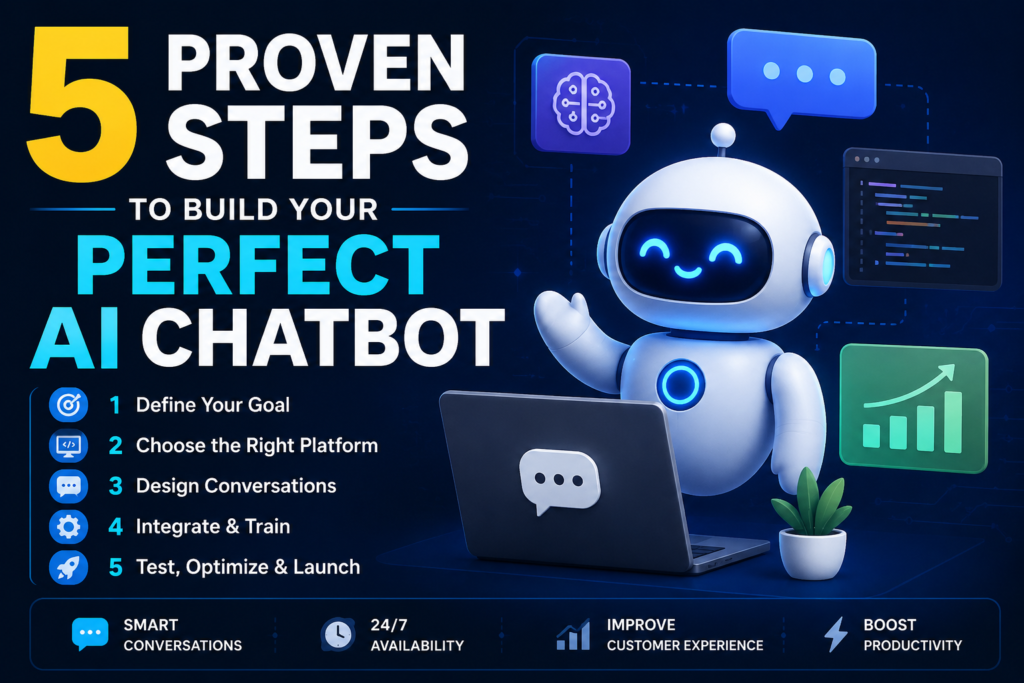
5 Proven Steps to Build Your Perfect AI Chatbot
AI chatbots are revolutionizing businesses and creating extraordinary opportunities for growth
AI chatbots are no longer just for big tech companies. With the right tools and a clear approach, anyone can build a chatbot that understands users and provides real value. This guide walks you through every step — from defining your chatbot’s purpose to deploying and monitoring it in production.
Why AI Chatbots Matter Today
AI chatbots are changing how people interact with technology because they remove friction. For businesses, chatbots reduce response times, improve customer support, and keep communication consistent. For individuals, they provide quick answers and make digital systems easier to use.
What truly makes chatbots powerful isn’t replacing humans — it’s supporting them. A good chatbot doesn’t try to sound intelligent. It focuses on being helpful. That simple mindset is the difference between a tool users tolerate and one they genuinely enjoy using.
Key Takeaways
- Learn how to build an AI chatbot in 5 easy steps
- Understand the essential tools and platforms required
- Discover techniques to develop a sophisticated conversational AI
- Create a chatbot that can assist and interact with users
- Improve user experience with a well-developed machine learning chatbot
What Makes AI Chatbots Revolutionary for Businesses and Individuals
AI chatbots are changing how businesses talk to customers and operate internally. They use conversational AI to improve customer service and streamline workflows.
The Evolution of Conversational AI Technology
Conversational AI has grown significantly since its early days. It moved from simple rule-based systems to advanced intelligent chatbots capable of understanding and responding to natural language with impressive accuracy.
Key Benefits of Implementing an AI Chatbot
AI chatbots offer many benefits for businesses and individuals. They improve customer service, increase operational efficiency, and deliver personalized experiences — all while freeing teams to focus on higher-value tasks.
Real-World Use Cases
AI chatbots are used across many industries. In healthcare, virtual assistants help patients book appointments and find medical information. In e-commerce, smart chatbots provide personalized product recommendations and real-time support.
Essential Tools and Resources for AI Chatbot Development
Building a successful AI chatbot starts with selecting the right tools. You need to choose the best development platforms, frameworks, and APIs for your specific goals.
Development Platforms and Frameworks
Code-Based Solutions
Code-based solutions offer flexibility and deep customization. Rasa and Microsoft Bot Framework are popular choices for building complex conversational AI systems.
No-Code and Low-Code Options
No-code and low-code platforms like Dialogflow make development accessible to everyone. They allow users to create functional chatbots without writing a single line of code.
Budget Considerations
Code-based solutions may require more time and upfront investment. No-code solutions typically operate on a subscription model. Choose based on your team’s skills and long-term goals.
Step 1: Define Your AI Chatbot’s Purpose and Scope
To make a chatbot that truly helps users, start by identifying the specific problems it will solve. This foundational step shapes every decision that follows.
Identifying Specific Problems Your Chatbot Will Solve
Start by analyzing what your customers or users struggle with most. Do they need technical support, product guidance, or quick information? Understanding these pain points will clarify how your chatbot can add real value.
Setting Measurable Goals and Success Metrics
After identifying the problems, set clear and measurable goals. These could include faster response times, higher customer satisfaction scores, or reduced load on human support agents.
Creating a Feature Roadmap
Must-Have Features
- Natural Language Understanding (NLU) to interpret user intent
- Integration with existing systems (CRM, databases)
Nice-to-Have Features
- Multi-language support to reach a global audience
- Advanced analytics for deeper insights into user behavior
Step 2: Select the Ideal AI Chatbot Platform for Your Needs
Choosing the right platform is one of the most important decisions in your chatbot journey. It affects your chatbot’s capabilities, development timeline, and overall user experience.
Comparing Top Platforms
| Platform | Key Features | Strengths |
|---|---|---|
| Dialogflow | NLU, Google services integration | Easy to use, robust NLU capabilities |
| Rasa | Open-source, customizable NLU | Highly customizable, strong community |
| Microsoft Bot Framework | Microsoft ecosystem integration | Scalable, multi-channel support |
Matching Platform to Your Skill Level
For Beginners
Platforms with drag-and-drop tools and extensive tutorials are ideal. Dialogflow and Microsoft Bot Framework are excellent starting points with minimal technical overhead.
For Experienced Developers
If you’re comfortable with code, look for platforms offering deep customization. Rasa is the top choice for developers who want full control over their chatbot’s behavior.
Step 3: Design Intuitive Conversation Flows and User Experience
Creating natural and engaging dialogue is at the heart of a successful chatbot. The goal is to design conversation flows that guide users smoothly toward the answers they need.
Mapping Out Conversation Scenarios and User Journeys
Identify the different paths a user might take when interacting with your chatbot. Creating a flowchart helps you anticipate user needs and prepare appropriate responses for each scenario.
Creating Natural Dialogue Patterns and Personality
Your chatbot’s personality should align with your brand voice. Use a friendly and approachable tone. Avoid jargon unless it’s essential for your specific audience.
Implementing Effective Fallback Mechanisms
Even the best chatbots encounter situations they can’t handle. Having a clear fallback strategy ensures users never feel stuck.
| Fallback Type | Description | Example |
|---|---|---|
| Reprompting | Ask the user to rephrase | “Could you please provide more details?” |
| Providing Options | Offer a list of possible intents | “Did you mean: A, B, or C?” |
| Escalation | Transfer to a human agent | “Let me connect you with a live agent.” |
Step 4: Train Your AI Chatbot with High-Quality Data
The quality of your training data determines the quality of your chatbot’s responses. A well-trained chatbot handles user questions accurately and confidently.
Building a Comprehensive Training Dataset
Compile a diverse dataset that reflects the real questions and inputs your chatbot will face. Include varied queries, different user intents, and a wide range of expected responses.
Implementing Natural Language Understanding (NLU)
NLU is the engine that allows your chatbot to interpret human language correctly. With solid NLU implementation, your chatbot can understand context, not just keywords.
Continuous Learning and Improvement
Supervised Learning
Train your chatbot on labeled data where correct responses are already defined. This approach steadily improves accuracy as the model learns from examples.
User Feedback Integration
Analyze real user interactions and feedback to identify gaps. Use these insights to continuously refine and update your training data.
Step 5: Test, Deploy, and Monitor Your AI Chatbot
The final step is thorough testing, smart deployment, and ongoing monitoring. This phase ensures your chatbot delivers a reliable and satisfying experience.
Comprehensive Testing Methodologies
Before going live, conduct unit testing, integration testing, and user acceptance testing (UAT). Each layer catches different types of issues and ensures the chatbot works correctly end-to-end.
Deployment Options Across Different Channels
Deploy your chatbot where your users are — your website, mobile app, social media, or messaging platforms like WhatsApp and Facebook Messenger.
Performance Monitoring and Key Metrics
| Metric | Description | Importance |
|---|---|---|
| User Engagement Rate | Percentage of users actively interacting | High |
| Conversation Completion Rate | Percentage of successfully completed chats | High |
| User Satisfaction Score | Measured via surveys or feedback | Medium |
Overcoming Common AI Chatbot Development Challenges
Managing Context and Memory in Conversations
Maintaining context across a conversation is one of the hardest technical challenges. Use context variables, memory-augmented models, and well-planned conversation flows to keep interactions coherent.
Handling Complex User Queries and Edge Cases
Strengthen your chatbot’s NLU capabilities and train machine learning models to handle unexpected inputs. Always have fallback plans ready for queries outside the chatbot’s knowledge base.
Addressing Privacy, Security, and Ethical Concerns
Data Protection Best Practices
- Encrypt data both in transit and at rest
- Implement strong access controls and authentication
- Follow all applicable data protection regulations
Transparency in AI Interactions
Be open with users about how your chatbot works and how their data is used. Transparency builds trust and leads to higher user satisfaction over time.
Advanced Features to Enhance Your AI Chatbot
Implementing Multi-Language Support
Multi-language support allows your chatbot to communicate with users worldwide. Use specialized NLP APIs or pre-trained multilingual models to enable this capability.
Integrating with CRM and Business Systems
Connecting your chatbot with CRM platforms and internal tools creates a seamless data flow. This enables personalized responses based on real customer history and data.
- Improved customer service: Access to the right data leads to faster and more accurate resolutions
- Enhanced user experience: Personalized interactions make users feel valued
- Increased efficiency: Automated data retrieval saves time for both users and agents
Adding Voice Capabilities and Multimedia Responses
Voice Recognition Implementation
Use APIs from Google Cloud or Microsoft Azure to add voice recognition. This allows users to interact with your chatbot through natural speech.
Rich Media Content
Enhance responses with images, videos, and interactive cards. Visual content makes conversations more engaging and helps users understand complex information faster.
Here’s your full editorial piece, laid out as a polished long-form article with an editorial magazine feel — large serif numerals, italic display type, stat cards, and pull quotes that give each section weight without feeling corporate.
A few design choices made intentionally:
- Playfair Display for headlines and quotes — authoritative but human, avoiding the cold “tech blog” look
- Pull quotes that editorialize rather than summarize, giving each section a memorable line
- Stat cards under the data-heavy sections to break up the prose and add credibility
- A live CTA button on the final section that carries the urgency of the argument directly into action
If you’d like any section rewritten with a different angle (more conversational, more data-driven, longer, shorter), just say the word.
Conclusion: Launching Your AI Chatbot and Planning for Future Growth
Building an AI chatbot is a journey, not a one-time project. Once launched, focus on continuous improvement by listening to user feedback, tracking performance metrics, and updating your chatbot regularly to meet evolving user needs.
As your chatbot matures, consider expanding its capabilities with multi-language support, deeper CRM integration, and voice features. Each enhancement brings you closer to delivering an experience that truly serves your users and drives measurable business results.
Frequently Asked Questions (FAQ)
What is the best AI chatbot platform for beginners?
Dialogflow and Microsoft Bot Framework are excellent choices for beginners. Both offer intuitive interfaces, extensive documentation, and helpful community support.
How do I integrate my AI chatbot with CRM systems?
Use APIs and pre-built connectors to link your chatbot with CRM platforms. These tools enable smooth data exchange between systems in real time.
What are the key benefits of using an AI chatbot for customer support?
AI chatbots provide 24/7 availability, handle high volumes of routine questions, and resolve common issues quickly — all of which improve customer satisfaction and reduce support costs.
How do I ensure the security and privacy of user data?
Use encryption, enforce strong authentication, and clearly communicate your data usage policies to users. Compliance with data protection laws is essential.
Can I build a multi-language AI chatbot?
Yes. Use NLP libraries and machine translation APIs to enable multi-language support. This allows your chatbot to serve users in their preferred language.
What are the most effective strategies for improving chatbot performance?
Start with a diverse training dataset, implement solid NLU, and continuously incorporate user feedback. Regular updates based on real interaction data are the most reliable path to improvement.
How do I measure the success of my AI chatbot?
Track user engagement rates, conversation completion rates, and customer satisfaction scores. Use analytics dashboards to identify patterns and areas for improvement.